
What’s the Real Difference and Which One Should You Choose?
If you’re comparing ceramic coating vs paint protection film (PPF), you’re not choosing “better protection.” You’re choosing which risk you want to reduce.
At FUNO, we explain it like this:
- Ceramic coating is primarily a chemical and maintenance layer. It improves hydrophobic behavior, helps resist chemical staining, and makes routine washing easier—but it does not provide meaningful impact protection against rock chips.
- PPF is a physical barrier layer designed to protect paint from common road impact and abrasion—especially stone chips and minor abrasions in high-impact zones.
Most owners who feel “misled” were sold the wrong solution for the wrong problem. This page is built to prevent that.
Quick Comparison Table
| Decision factor | Ceramic Coating | Paint Protection Film (PPF) |
|---|---|---|
| Best at | Chemical resistance + easier cleaning | Physical protection (impact/abrasion) |
| Helps most with | Water beading, grime release, UV/oxidation, chemical stains | Stone chips, bug splatter, minor abrasions in high-impact areas |
| Does not do well | Rock chips and dents; not “scratch-proof” | Not a guarantee of zero damage; severe impacts can still mark film/paint |
| Look & feel | Enhances gloss; slick surface | Gloss/matte/satin options; film is a visible layer on close inspection |
| Typical buyer goal | “Keep it cleaner, longer” | “Stop the damage that hits it” |
| Best combined outcome | Coating on top improves cleaning and surface behavior | PPF handles impact; coating can be layered for easier maintenance |
What Each One Is
What is ceramic coating?
Ceramic coating is commonly described as a liquid polymer layer that bonds to the paint surface, improving hydrophobic behavior and resistance to contaminants and chemical staining. It’s best treated as a maintenance and chemical-resistance upgrade, not a physical armor.
What is paint protection film?
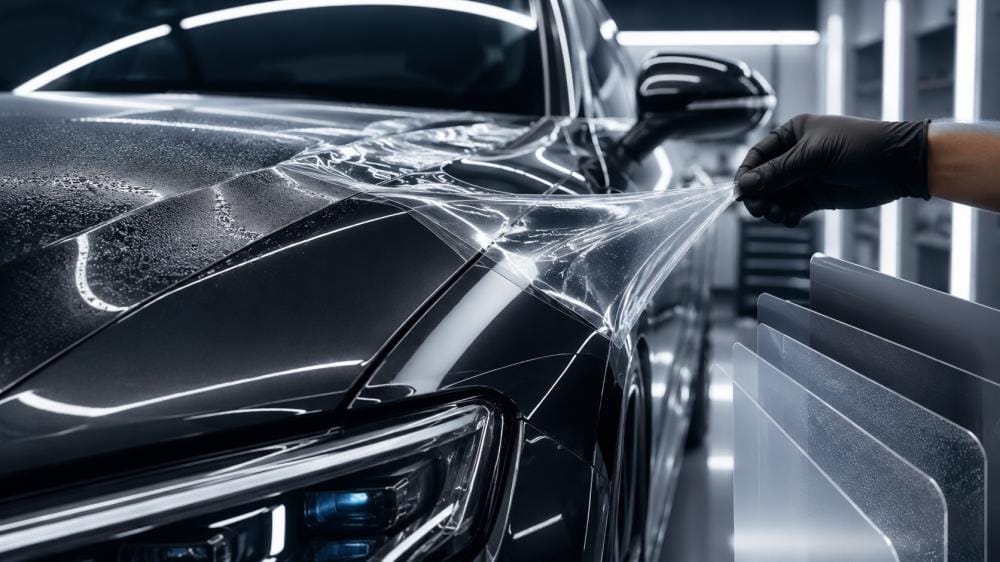
Paint protection film (PPF) is widely described as a thermoplastic urethane film applied to painted surfaces to protect against stone chips, bug splatter, and minor abrasions, typically in high-impact areas like the front bumper, hood, fenders, mirrors, and rocker panels.
The common “why it works” explanation: it acts as a barrier that absorbs and disperses impact energy before it reaches the paint.
Protection Reality Map: What Works for What?
This is the fastest way to choose correctly.
Rock chips and road debris
- PPF wins because it’s built as a physical layer intended to take the impact.
- Ceramic coating does not provide meaningful rock chip protection.
Chemical stains, bird droppings, road salt, and grime
- Ceramic coating is typically stronger here because it’s positioned for chemical resistance and easier contaminant release.
- PPF can still help, but you’re relying on film/topcoat behavior and cleaning discipline (not “chemical immunity”).
Light wash marring / swirl risk
- Ceramic coating can reduce micro-marring risk in some cases, but it is not scratch-proof.
- Some PPF systems are described as “self-healing” in general industry descriptions, but you should treat “healing” as minor surface marks, not deep scratches.
Door dings and dents
- Neither is a dent shield. If impact is large enough to deform the panel, film/coating won’t prevent that.
Longevity: What Lasts Longer?
This is where most comparisons get messy because people compare “marketing years” instead of real-life wear.
At FUNO, we separate durability into:
- Functional life: it still performs its intended job.
- Appearance life: it still looks the way you want (gloss level, clarity, uniformity).
General industry guidance often frames PPF as a longer-term protection layer (commonly “years”) when properly installed and maintained.
Ceramic coatings can also last years, but the results depend heavily on surface prep, curing, and ongoing wash practices (because the coating is thin and maintenance-driven).
Practical takeaway:
If your goal is impact protection, you choose PPF first. If your goal is easy cleaning + chemical resistance, ceramic coating can be the first choice. Many owners combine both to cover both risk types.
Maintenance and Ownership Cost
What ceramic coating changes in ownership
- Washing typically becomes faster because dirt releases more easily and water behavior improves.
- The coating still requires correct wash habits; it does not eliminate maintenance.
What PPF changes in ownership
- You reduce the frequency of paint damage that forces touch-ups or repainting in high-impact zones.
- PPF can also reduce the “stress cost” of daily driving if you’re in chip-heavy conditions.
Which One Should You Choose? Scenario Rules We Use
Use these rules to decide in under a minute:
Choose PPF first if…
- You drive highways, gravel routes, construction corridors, or chip-heavy roads.
- Your vehicle has high repaint sensitivity (premium paint, complex bumper shapes).
- You want the strongest physical protection where damage usually starts (front end).
Choose ceramic coating first if…
- Your biggest frustration is cleaning, water spotting, and chemical fallout.
- You want gloss enhancement and lower wash friction as the primary outcome.
Choose both if…
- You want impact protection + easy maintenance: PPF handles what hits the paint; ceramic coating improves surface behavior and cleaning efficiency.
Can You Combine Both?
Yes. Many installers apply a coating over PPF to improve cleaning and surface behavior.
From our manufacturer viewpoint, the correct way to think about the stack is:
- PPF = physical barrier layer
- Ceramic coating = surface behavior layer
We also set a boundary for clarity: combining both does not turn your car into a “zero damage” system. It’s risk management, not invincibility.
Buyer Checklist
If you want fewer regrets, confirm these items:
- Your real risk model: rock chips vs chemical staining vs both.
- Your finish goal: gloss vs satin/matte look and how picky you are about uniformity.
- Your installation standard: the deliverable is not just material; execution determines edge stability and appearance.
- Your expectation boundary: coatings are not rock-chip shields; PPF is not a guarantee of zero impact marks.
- Your maintenance reality: coatings pay off when wash habits are consistent; PPF pays off when your exposure is chip-heavy.
FAQs
Is ceramic coating better than PPF?
Not broadly. Ceramic coating is stronger for chemical resistance and easier cleaning; PPF is stronger for physical impact and abrasion risk.
Does ceramic coating protect against rock chips?
No meaningful rock chip protection. That’s a physical impact problem, and ceramic coatings are not built as impact shields.
Does PPF stop rock chips completely?
PPF is designed to protect against stone chips, but it’s not a guarantee of zero damage in every impact scenario.
Does ceramic coating prevent scratches?
It can help reduce micro-marring risk, but it is not scratch-proof.
Can I do ceramic coating over PPF?
Yes, this is commonly done to improve cleaning and surface behavior on top of the film.
Which should I do first?
Choose based on your dominant risk. If rock chips are your pain point, prioritize PPF. If cleaning and chemical staining are your pain point, prioritize ceramic coating. For full coverage, many owners layer coating over PPF.
Is ceramic coating worth it if I already have PPF?
Often yes if your goal is easier cleaning and better contaminant release on the film surface (assuming you’ll maintain it).
What’s best for fleets and installer networks?
We recommend a risk-based package: high-impact PPF coverage where chips drive cost, and optional coating where cleaning time and appearance consistency matter.
Working With FUNO
At FUNO, we manufacture PPF programs for importers, distributors, brand owners, and installer networks. If your market needs a clear decision framework, we typically align on:
- the risk model you sell (impact vs chemical vs both),
- the finish lineup (gloss / satin / matte / color),
- and the delivery standard (documentation pack + batch consistency + private label execution).
That way, your customers don’t buy “a promise.” They buy an outcome they can recognize.
Related Posts



Contact FUNO
Tell us your target market, product category, preferred specification, estimated purchasing volume, and whether you need standard or private label supply.
FUNO can help you narrow suitable film options, sample requirements, packaging needs, and the next step toward bulk purchasing.