
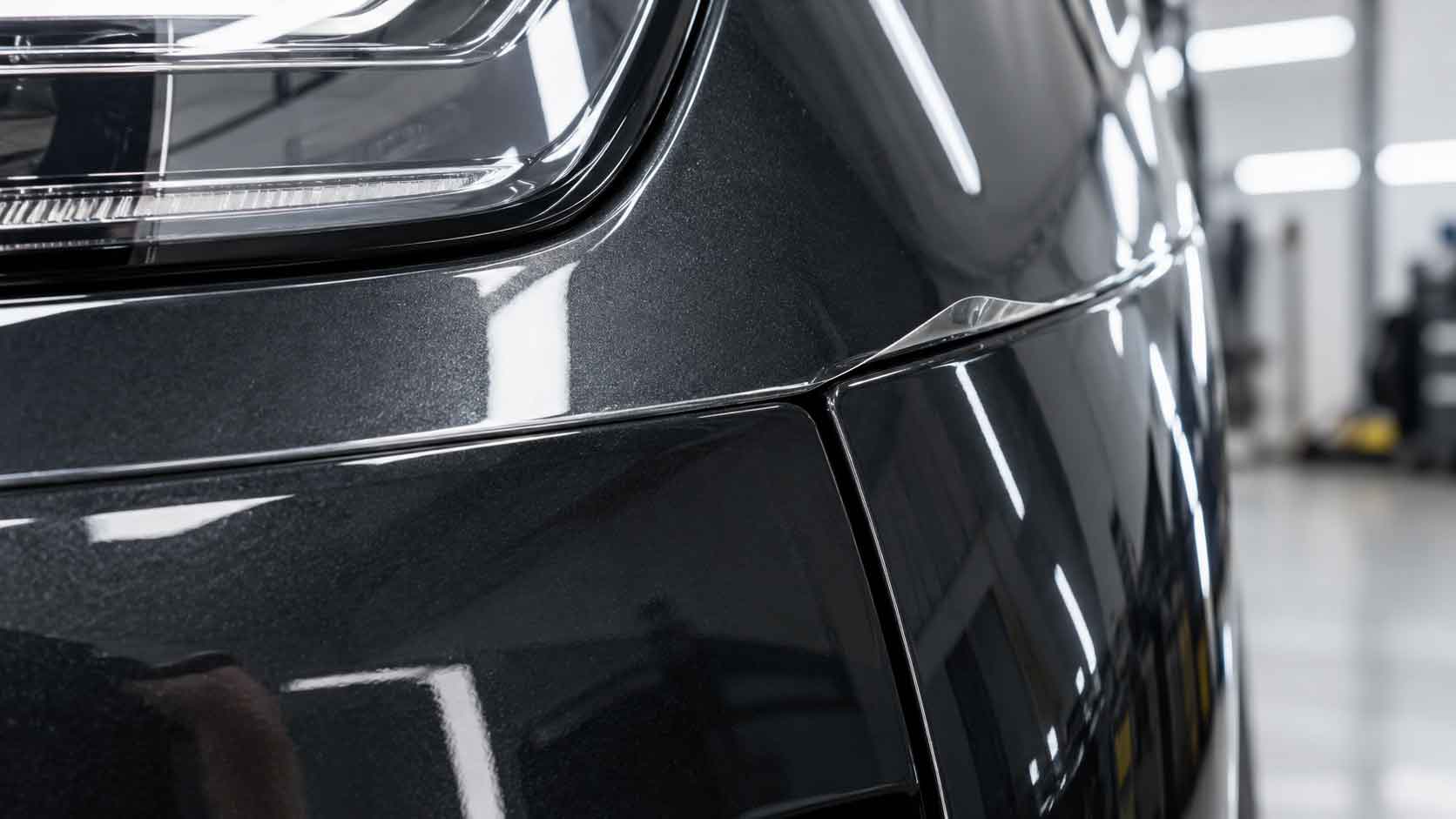
PPF edge lifting usually happens when the force pulling the film away from the panel becomes greater than the adhesive bond holding it down.
The cause may be surface contamination, trapped installation solution, excessive stretch, poor edge finishing, unsuitable temperature, repeated repositioning, or later mechanical stress.
For installers and PPF distributors, the important question is not simply:
“Is the adhesive strong enough?”
A good edge depends on the complete system:
surface preparation + film tension + adhesive contact + installation method + panel geometry + aftercare
This is why stronger adhesive alone does not solve every edge-lifting problem.
Quick Answer: Why Do PPF Edges Lift?
The most common causes of PPF edge lifting are:
- contamination near the edge;
- excessive stretch or stored tension;
- moisture or slip solution left under the edge;
- insufficient edge pressure;
- repeated lifting and repositioning;
- unsuitable installation temperature;
- washing or mechanical stress before the edge is stable.
The correct diagnosis should consider where the lift appears and when it starts.
A bumper corner that repeatedly pulls back is different from a flat edge contaminated by wax.
Why Are PPF Edges More Difficult Than Flat Areas?
The middle of a flat panel is normally easier to bond.
It has:
- a larger contact area;
- less concentrated tension;
- fewer sharp changes in direction;
- less direct exposure to washing and airflow.
Edges are different.
They often have:
- less adhesive contact area;
- more stretch;
- tighter curves;
- more stored tension;
- more contamination around panel gaps;
- more exposure to water and mechanical force.
This creates an important difference:
The center of a PPF panel mainly needs adhesion. The edge needs adhesion plus tension control.
A film can look perfect across the center of a hood and still fail around one corner if tension is concentrated there.
Cause 1: Surface Contamination Near the Edge
PPF adhesive needs a clean surface.
Even a small amount of contamination can reduce contact.
Common contamination includes:
- wax;
- polish;
- silicone;
- ceramic coating residue;
- grease;
- fingerprints;
- dust;
- road contamination.
Edge areas are often more difficult to clean than the center of the panel.
Contamination may remain around:
- trim;
- badges;
- panel gaps;
- bumper openings;
- door edges;
- mirror bases.
If the adhesive contacts contamination instead of clean paint, stronger adhesive cannot fully solve the problem.
Why Edge Cleaning Needs More Attention
The last few centimeters near the edge often carry the highest tension.
That means this area needs reliable adhesive contact.
A small loss of adhesion in the center may not immediately create lifting.
The same contamination at a highly stretched edge can cause early failure.
Cause 2: Too Much Film Tension
Excessive tension is one of the most important causes of edge lift.
PPF is flexible, but it still tries to recover after being stretched.
If the installer pulls the film strongly across a bumper or corner and leaves that tension at the edge, the film continuously tries to return toward its original shape.
This creates a pulling force against the adhesive.
Common High-Tension Areas
These include:
- bumper corners;
- mirror caps;
- deep curves;
- narrow returns;
- wrapped edges;
- sharp body lines.
The correct solution is not simply:
“Use stronger glue.”
The better approach is to control where the film is stretched and where the tension is released.
Stored Tension Matters
The film may stay down immediately after installation.
But if too much tension remains, the edge may lift later.
That can happen:
- after several hours;
- after temperature changes;
- after washing;
- after normal vehicle use.
This is why installers should not judge edge stability only in the first few minutes.
Cause 3: Slip Solution or Moisture Left at the Edge
Wet-install PPF needs controlled solution management.
Slip solution helps the installer position the film.
But before the edge is finished, excess liquid needs to be removed so the adhesive can contact the surface correctly.
If too much solution remains at the edge, the adhesive may not build enough early contact.
This is especially important around:
- wrapped edges;
- bumper returns;
- tight corners;
- recessed areas.
A clean-looking edge may still have moisture underneath.
If that area is also under tension, lifting becomes more likely.
Do Not Use One Solution Ratio for Every PPF
Different PPF systems can require different installation methods.
The exact:
- slip solution;
- tack solution;
- temperature;
- edge-finishing process
should follow the current guidance for the film being installed.
Do not assume a formula that worked with one supplier will give identical results with another.
Cause 4: Insufficient Edge Pressure or Final Set
The edge needs complete adhesive contact.
If the installer finishes the main panel but does not give enough attention to the perimeter, the edge may remain only partially bonded.
Possible problems include:
- insufficient squeegee pressure;
- solution still present;
- poor contact around curves;
- incomplete final inspection.
Some PPF systems also specify controlled heat as part of finishing difficult edges or curves.
That does not mean every PPF adhesive must be “heat activated.”
Most professional PPF uses pressure-sensitive adhesive.
Heat may help with film shaping, moisture management or final edge setting depending on the exact product.
Always follow the procedure for the specific film series.
Cause 5: Repeated Lifting and Repositioning
Repositionability is useful during installation.
But it is not unlimited.
When a film is first placed lightly, the installer may be able to:
- slide it;
- lift it;
- adjust it;
- reposition it.
After stronger pressure has been applied, adhesive contact becomes more developed.
If the installer repeatedly lifts the same area after that point, the edge may become less predictable.
Repeated lifting can introduce:
- contamination;
- adhesive disturbance;
- glue lines;
- uneven tension.
If the area is also a high-tension corner, the risk increases.
For a deeper explanation of tack, repositionability and bond development, see our PPF adhesive guide.
Cause 6: Installation Temperature Is Too Low or Unstable
Temperature affects:
- film flexibility;
- adhesive response;
- tack;
- stretch;
- settling.
In a cold workshop, the film may feel firmer and the adhesive may behave differently.
In a very hot environment, tack may build faster and working time may change.
Large temperature changes during or immediately after installation can also affect edge behavior.
The correct installation range depends on the exact PPF.
Do not use one temperature specification for every film series.
Check the current product guidance.
Cause 7: Poor Edge Geometry or Too Little Wrap
Some panels are naturally difficult.
For example:
- narrow bumper returns;
- sharp corners;
- complex mirror shapes;
- tight gaps around trim.
In these areas, a small change in cut line or wrap distance can change the amount of tension at the edge.
An installer may need to decide whether the edge should be:
- exposed;
- wrapped;
- trimmed differently;
- finished with less tension.
There is no single edge strategy for every panel.
Vehicle geometry matters.
Cause 8: Washing and Mechanical Stress
A properly installed edge can still be damaged later.
Mechanical stress may come from:
- pressure washers;
- automatic car washes;
- strong brushes;
- aggressive drying;
- dirt entering a partially lifted edge.
A pressure washer aimed directly at the edge can create force under the film.
If the edge is already slightly loose, water pressure may make the problem worse.
This is why new installations should follow the correct settling and aftercare guidance before aggressive washing.
Is the Problem Adhesive Strength or Film Tension?
These are related, but they are not the same.
A useful diagnosis starts with the location and pattern.
| Symptom | More Likely Direction |
|---|---|
| Lift appears only on a tight bumper corner | Tension / geometry |
| Lift appears where wax or coating remains | Surface preparation |
| Several flat edges lift | Adhesive contact / moisture / process |
| Lift appears after repeated repositioning | Adhesive disturbance |
| Lift happens after pressure washing | Mechanical stress / aftercare |
| Same batch repeatedly needs edge rework | Film / adhesive / batch investigation |
This does not prove the cause by itself.
It helps decide what to check first.
Why Stronger Adhesive Does Not Automatically Solve Edge Lift
A stronger adhesive may hold more force.
But it cannot remove stored tension from a badly stretched film.
This is an important purchasing point.
If one film uses very aggressive adhesive, it may:
- anchor strongly;
- grab faster;
- hold edges well in some situations.
But it may also become:
- harder to reposition;
- less forgiving during installation;
- more likely to show adhesive disturbance after rework.
The goal is not maximum adhesive strength.
The goal is balance.
A professional PPF needs:
- manageable tack during positioning;
- stable contact after installation;
- controlled edge behavior;
- predictable removal later.
That is why edge stability should be tested as an installation property, not judged only from peel-strength data.
Can Overstretching Cause Edge Lift?
Yes.
When a PPF is overstretched, the film stores more recovery force.
The installer may make the film fit the panel temporarily, but the material continues trying to return toward its original shape.
The edge becomes the weak point.
This is especially common when tension is concentrated instead of distributed.
Overstretch can also create visible defects such as:
- stretch marks;
- whitening;
- distortion.
We explain those visual symptoms in our guide to PPF silvering, glue lines and stretch marks.
But edge lift is a different result.
Stretch marks show what happened to the film surface.
Edge lift shows what happens when stored tension reaches the perimeter.
Can a Lifted PPF Edge Be Repaired?
Sometimes.
The correct decision depends on:
- how much film has lifted;
- whether contamination entered;
- whether the film is distorted;
- whether the edge has lifted before.
Small, Clean and Recent Lift
A professional installer may be able to rework a small clean edge if:
- contamination is limited;
- the film has not stretched out of shape;
- adhesive condition is still acceptable.
The exact repair method depends on the PPF.
Contaminated Lifted Edge
Once an open edge collects:
- dust;
- dirt;
- wax;
- moisture,
reliable re-adhesion becomes more difficult.
Pressing contamination back under the film may create a poor visual result and another future lift.
Repeated Edge Lift
If the same area keeps coming back, stop simply pressing it down.
Check:
- stored tension;
- panel geometry;
- contamination;
- adhesive behavior;
- film selection;
- installation method.
Repeated lift usually indicates that the underlying cause has not been solved.
When Should the Film Be Replaced Instead of Re-Tacked?
Replacement may be the better choice when:
- contamination is trapped under the edge;
- the film is permanently distorted;
- the topcoat is damaged;
- the edge has lifted several times;
- a large area has separated;
- the film cannot stay down after correct finishing.
Professional installation should focus on the final quality of the panel.
Saving a damaged film is not always the lowest-cost option once rework time and customer complaints are considered.
Why Bumper Corners and Mirrors Need Special Attention
Not all panels create the same installation load.
Bumpers
Bumpers often combine:
- large stretch;
- compound curves;
- narrow edges;
- recessed areas.
This makes them one of the best places to evaluate real PPF conformability and edge stability.
Mirrors
Mirror caps are small but can require strong three-dimensional shaping.
Poor tension distribution becomes obvious quickly.
Wrapped Hood and Fender Edges
These areas may look simple, but edge preparation and moisture removal still matter.
For distributors testing a new film, flat hood samples alone are not enough.
A real sample program should include at least one complex area.
How Should Distributors Test Edge Stability Before Bulk Buying?
Edge stability should be part of sample approval.
Do not judge a film only by:
- thickness;
- material;
- peel strength;
- warranty.
Install it.
Step 1: Use the Same Installer
Installer technique can strongly affect the result.
Using the same experienced installer makes product comparisons more useful.
Step 2: Keep Temperature Similar
Record workshop conditions.
Do not compare one film in a cold shop and another in a warm shop.
Step 3: Use Similar Panels
Use the same vehicle or similar panel geometry.
Step 4: Test a Flat Area
This gives a baseline for adhesive behavior.
Step 5: Test a Curved Area
Use a bumper or similar compound curve.
Step 6: Test a Wrapped Edge
Check how the film behaves when it needs to return around an edge.
Step 7: Test a High-Tension Area
Mirrors and bumper corners can reveal differences that a flat panel hides.
Step 8: Record Immediate Edge Behavior
Check:
- how much pressure was needed;
- whether the edge stayed down;
- whether extra tack was required;
- whether the film kept pulling back.
Step 9: Inspect Again After Settling
Do not stop the test when the installer finishes the panel.
Check the edge later.
Step 10: Record Rework
This is very important.
Ask:
- Did the edge need extra pressure?
- Did it require repeated finishing?
- Was heat repeatedly needed?
- Did the installer need to return later?
This creates much more useful purchasing data.
For a broader evaluation process, see our guide on how to test PPF samples before bulk buying.
Track Edge Rework Instead of Using Only Pass/Fail
A distributor can learn more by recording rework.
For example:
| Film | Panels Installed | Edge Rework Events |
|---|---|---|
| Current Supplier | 20 | Record actual result |
| Sample A | 20 | Record actual result |
| Sample B | 20 | Record actual result |
This is not an industry standard.
It is an internal comparison tool.
It helps answer:
Which film creates more installer work?
That matters commercially.
A film with a slightly lower purchase price may become more expensive if it creates:
- more rework;
- longer installation time;
- more customer callbacks.
Film Problem or Installer Problem: How Should Buyers Judge?
Do not decide from one failed edge.
Look for a pattern.
One Installer, One Isolated Edge
Check first:
- local contamination;
- tension;
- moisture;
- panel geometry;
- finishing method.
One Installer, Several Panels
Check:
- installer technique;
- installation solution;
- temperature;
- product behavior.
Several Installers, Same Film, Same Problem
Increase attention on:
- tack;
- film recovery;
- edge behavior;
- product specification.
Approved Sample Was Fine, New Batch Needs More Rework
Now batch consistency becomes an important question.
The correct principle is:
Use repeatable evidence before assigning the cause.
When Does Edge Lift Become a Batch-Consistency Question?
A distributor should pay more attention to batch consistency when:
- the installer team has not changed;
- the workshop process has not changed;
- the same vehicle types are being installed;
- the new production batch behaves differently.
Possible signs include:
- weaker edge hold;
- more pullback;
- different tack;
- more edge rework;
- different stretch recovery.
This does not automatically prove a factory problem.
But it is enough to justify comparison with:
- approved sample;
- previous accepted batch;
- retained sample;
- another roll from the same batch.
Our PPF Incoming Quality Inspection Guide explains how importers can connect installation checks with batch numbers and receiving records.
Edge Stability Should Be Checked Again on Repeat Orders
One good sample is not enough.
Professional distributors need repeatability.
A supplier should be able to reproduce:
- tack direction;
- stretch behavior;
- edge stability;
- surface appearance.
If the first sample installs well but later production consistently requires more edge work, that becomes a supply issue even if the material name and thickness remain unchanged.
This is why repeat-order performance matters as much as initial sample approval.
What Can a Technical Data Sheet Tell You About Edge Stability?
A TDS may help with:
- material;
- thickness;
- peel adhesion;
- application temperature;
- other measurable properties.
But it cannot fully predict:
- bumper edge behavior;
- wrapped corner pullback;
- installer rework;
- real tension management.
This is why edge stability needs practical installation testing.
A peel number measured on a flat standard substrate is useful technical data.
It is not the same as a stretched PPF edge on a complex bumper.
How Should Private Label Buyers Define Edge-Performance Requirements?
Do not send only:
“We need strong edge adhesion.”
That is too vague.
A stronger OEM brief can include:
Installer Type
Are your customers:
- experienced PPF shops;
- mixed-skill installers;
- dealer networks?
Common Vehicles
Do they mainly install:
- standard passenger cars;
- luxury vehicles;
- sports cars;
- complex bumpers?
Edge Style
Do they use:
- exposed edges;
- wrapped edges;
- pre-cut patterns;
- bulk installation?
Climate
Are installations mainly performed in:
- hot markets;
- cold markets;
- mixed climates?
Current Supplier Reference
If your current product has a known installation feel, provide the reference.
Rework Expectation
Ask installers to compare:
- edge finishing time;
- repeated pressure;
- pullback;
- callback frequency.
Approved Sample
Keep the approved film as a practical reference for repeat production.
This turns:
“strong glue”
into a much more useful product requirement.
How FUNO Evaluates Edge Performance
At FUNO, edge stability is part of installer-oriented PPF evaluation.
We do not recommend judging professional PPF only from adhesive strength.
Important factors include:
- initial tack;
- repositionability;
- stretch;
- conformability;
- edge stability;
- adhesive consistency;
- installer feedback.
Our production system includes TPU casting, high-precision optical coating, slitting, inspection and finished-roll preparation.
For repeat supply, important control areas include:
- film consistency;
- coating consistency;
- thickness control;
- adhesive performance;
- batch stability.
For distributors, one successful sample installation is only the beginning.
The same edge behavior should remain as predictable as possible on later production batches.
Why Edge Performance Matters to Distributors
Edge lifting creates more than a technical problem.
It can create:
- installer frustration;
- longer installation time;
- customer callbacks;
- panel rework;
- film waste;
- warranty discussions.
For a distributor, these costs matter.
That is why supplier evaluation should ask not only:
“What is the roll price?”
but also:
“How much installer rework does this film create?”
Our PPF supplier checklist explains why installer feedback and repeat-batch performance should be part of supplier comparison.
FAQ
Why does PPF keep lifting at the edges?
Common causes include contamination, trapped solution, excessive tension, poor edge finishing, repeated repositioning or later mechanical stress.
Repeated lifting usually means the underlying cause has not been solved.
Is PPF edge lifting caused by weak adhesive?
Not always.
A strong adhesive can still fail if too much tension remains in the film or the surface is contaminated.
Can overstretching cause PPF edge lift?
Yes.
Overstretching creates stored tension that can continue pulling the film away from the edge.
Can pressure washing lift PPF edges?
Yes, especially if the nozzle is aimed directly at an exposed or already loose edge.
Mechanical water pressure can make a small lift worse.
Can a lifted PPF edge be repaired?
Sometimes.
A small, clean and recent lift may be suitable for professional rework.
If the area is contaminated, distorted or repeatedly lifts, replacement may be more reliable.
How should distributors test edge stability?
Use real installation tests on flat and curved panels.
Include wrapped edges, bumper corners or mirrors, and record how much rework is required after installation.
Edge Lift Is a System Problem, Not Just a Glue Problem
PPF edge lifting should not be diagnosed from adhesive strength alone.
The final result depends on:
surface preparation + film tension + adhesive contact + moisture control + panel geometry + installation temperature + aftercare
A stronger adhesive cannot remove stored tension.
A flexible film cannot bond reliably to a contaminated surface.
A perfect installation can still be damaged by aggressive washing.
For installers, the goal is to control these factors before the edge becomes a problem.
For distributors, the goal is different:
Approve a film that gives predictable edge behavior across real panels, real installers and repeat production batches.
Before bulk buying:
Test the exact film.
Use real curves and wrapped edges.
Record rework.
Keep the approved sample.
Compare repeat batches.
FUNO supports distributors, installer networks and private label buyers with product selection, sample evaluation, specification alignment and repeat supply through our PPF OEM and private label service.
A good PPF edge is not created by adhesive alone.
It is created when the film, adhesive, panel and installation method work together.
Related Posts



Contact FUNO
Tell us your target market, product category, preferred specification, estimated purchasing volume, and whether you need standard or private label supply.
FUNO can help you narrow suitable film options, sample requirements, packaging needs, and the next step toward bulk purchasing.