
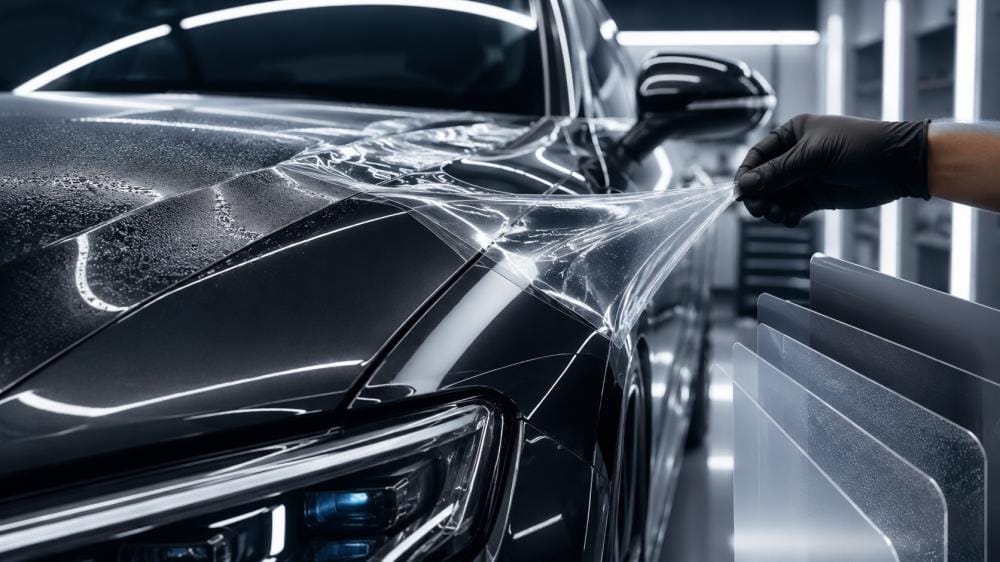
Yes—paint protection film (PPF) really works when you judge it by the right outcome: it reduces the frequency and severity of common paint damage (especially rock chips, abrasion, stains, and weathering) and helps keep the finish looking “just installed” longer. That’s exactly how leading film manufacturers describe its design intent.
At FUNO, we also set one expectation upfront: PPF is a sacrificial layer. It’s designed to take the abuse before your clear coat does—but it’s not a guarantee of zero damage.
Quick reality table
| What you’re really asking | What we can say with confidence |
|---|---|
| Does PPF work for rock chips? | PPF is explicitly positioned as protection against rock/stone chips and related road impact in major TDS/PDS documents. |
| Does it work for scratches? | Many systems include self-healing for minor scratches/marks (typically heat/time assisted). Deep gouges are out of scope. |
| Does it help with staining/weathering? | Many premium films are described as resisting staining and weathering, often via low surface-energy topcoat systems (series-dependent). |
| Why do some people say “PPF didn’t work”? | Wrong expectation, wrong coverage, inconsistent installation/QA, or a risk profile that exceeds what PPF is designed to manage. |
What PPF is designed to protect against
When we evaluate “does it work,” we look at what reputable technical documents consistently list as the target threat set:
- Stone/rock chips and road debris impact
- Abrasion and scuffing from daily driving
- Insect stains and environmental fallout
- Outdoor weathering and appearance degradation over time
That’s the “work” PPF is built for: predictable, high-frequency damage modes that accumulate cost and degrade finish.
Self-healing: what it really means
Self-healing is real—but it’s also the most misunderstood feature. Here’s how we explain it at FUNO:
- Some films explicitly state they can remove minor scratches or marks with heat.
- Some technical sheets describe elastomeric polymers in the clear coat that allow surface scratches to “heal” over time.
- Product data sheets also commonly describe a heat-activated self-healing top coat that improves scratch resistance.
The boundary that protects your project: self-healing claims are best interpreted as minor/light surface marks—not deep cuts, not sharp-object gouges, and not major impact damage.
What PPF does not do
This is where we keep your expectations—and your warranty risk—aligned:
- It is not “chip-proof” or “scratch-proof.” PPF reduces probability and severity; it doesn’t rewrite physics.
- It does not prevent all damage from hard impacts. A severe hit can still mark the film and/or the paint underneath.
- It does not compensate for poor installation. Even the best film can underperform if surface prep, alignment, edge finishing, and contamination control are not executed consistently.
What determines whether PPF “works” on your car
At FUNO, we use a simple operating model: Performance = film system + installation quality + coverage strategy + usage reality.
1) Film system design
High-quality systems often describe:
- Low surface energy to resist staining and environmental contaminants, plus gloss retention.
- Hydrophobic/easy-maintenance surface features in certain series.
- Topcoats designed for scratch resistance and self-healing behavior (minor marks).
2) Installation quality and QA
This is where most “PPF didn’t work” complaints originate. Film performance is delivered through process discipline: consistent prep, fit, edge control, and final inspection.
3) Coverage strategy
PPF works best where exposure is highest:
- front bumper
- hood leading edge
- fender leading edges
- mirrors
- rocker panels/lower doors
Full front and full vehicle options improve uniformity and long-term appearance consistency, but ROI depends on the driver’s exposure.
4) Your real-world risk profile
If you drive high-speed highways, gravel routes, construction corridors, or you park in tight urban conditions, your probability of chips and abrasions rises sharply—and PPF ROI usually improves with it.
If you’re sourcing PPF for resale: how we support OEM/ODM at FUNO
This page is about whether PPF works—but many of our readers are also importers, distributors, brand owners, and installer networks who need a product that performs consistently in-market.
Here’s how we keep it procurement-ready without diluting the topic:
- Documentation pack (available upon request): finish catalog (gloss/matte/satin/color), series positioning, and relevant TDS/PDS so you can verify claims and boundaries.
- Consistency mindset: we treat “works” as a repeatable output—batch traceability, QC checkpoints, and controlled packaging for transit.
- OEM/ODM execution: private-label branding workflows, sample support, and roll-level supply planning aligned to your channel launch cadence.
The practical result: you can sell “PPF works” with confidence because your end customers will see outcomes that match the documented intent—chips/abrasion/stains/weathering reduction and minor-mark recovery where applicable.
Buyer checklist: how to evaluate “PPF works” before you commit
If you want to buy correctly (and avoid disputes), use this checklist:
- Ask for TDS/PDS that explicitly state the target threat set (chips, abrasion, staining, weathering) and the self-healing boundary (minor marks).
- Confirm the finish objective (gloss vs matte vs satin vs color) and how it will look panel-to-panel in your market.
- Align on installation QA criteria (edges, clarity, contamination tolerance, inspection under standard lighting).
- Choose coverage based on exposure (high-impact vs full front vs full vehicle).
- Document limitations in writing (risk reduction, not guarantee).
FAQs
Does paint protection film really work for rock chips?
PPF is explicitly positioned as protection against rock/stone chips and road abrasion in major technical documents.
Will PPF stop scratches?
It helps most with minor/light surface marks, and many systems include self-healing behavior within that boundary. Deep damage is not the intended scope.
Does self-healing mean scratches disappear automatically?
Self-healing is commonly described as heat/time-assisted recovery of surface marks via topcoat chemistry. It should be understood as “minor marks,” not deep cuts.
Does PPF help with stains and weathering?
Many premium films are described as resisting staining and offering environmental resistance; validate by series documentation.
Is PPF worth it?
It’s most worth it when exposure is high (highway/gravel/urban parking) and long-term appearance consistency matters. Low exposure reduces ROI.
Does installation quality really matter that much?
Yes. Film performance is delivered through installation quality and QA. The same film can perform very differently depending on execution.
Can PPF be matte or satin and still “work”?
Yes—matte/satin variants are still positioned as protective films, often with self-healing topcoats.
What should I request from a supplier before placing an OEM order?
Ask for catalog by finish, TDS/PDS, sample confirmation workflow, and a documented claim boundary (minor marks, risk reduction).
Next step
If you want a decision you can stand behind, we recommend starting with your exposure profile (high-impact vs full-front vs full-vehicle) and your finish target (gloss/matte/satin/color). We’ll align the recommendation to documented performance intent and provide an OEM/ODM-ready pack: catalog + TDS/PDS + sample plan + lead time & MOQ.
Related Posts




Contact FUNO
Tell us your target market, product category, preferred specification, estimated purchasing volume, and whether you need standard or private label supply.
FUNO can help you narrow suitable film options, sample requirements, packaging needs, and the next step toward bulk purchasing.