
The closest answer is usually reflective privacy window film. It is the option most commonly used when you want to keep your outward view while making it harder for people outside to see in during the day. Reflective solar films are marketed specifically for daytime privacy, and they also commonly help with glare, heat, and UV reduction.
But there is one important limit: this effect is usually daytime privacy, not all-day one-way privacy. Mirrored or reflective privacy film relies on a difference in light levels. When the outside is brighter than the inside, it is harder to see in. When the inside becomes brighter than the outside at night, that privacy effect can weaken or even reverse.
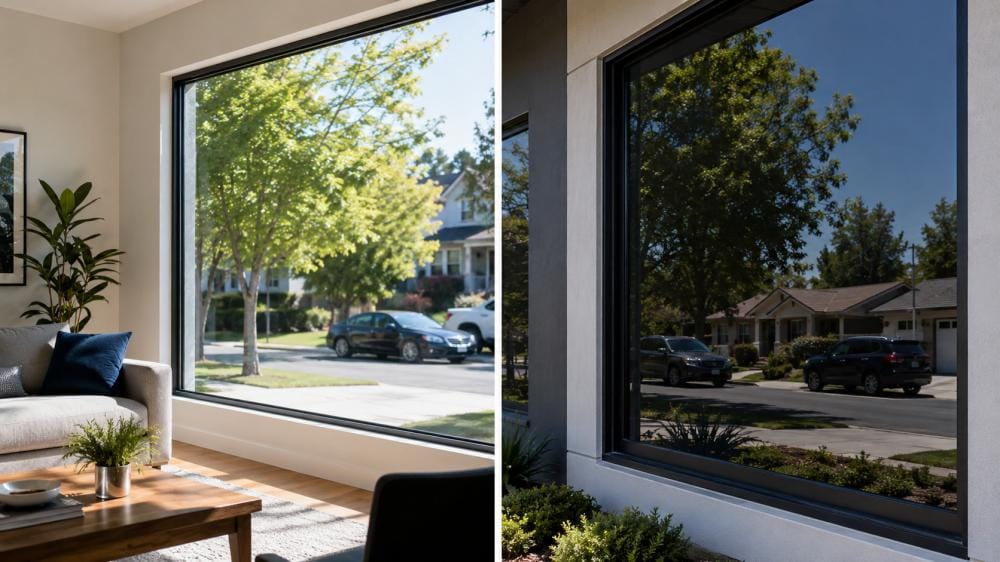
So the real answer depends on what kind of privacy you mean. If you want daytime privacy while preserving the view out, reflective or dual-reflective film is usually the best fit. If you want more stable privacy regardless of daytime reflection, decorative or frosted privacy film is often the better choice, even though it changes the look of the glass more.
The Short Answer: What Actually Works Best
Reflective window film for daytime privacy
If your main goal is to see out while reducing how easily people can see in from outside during the day, reflective window film is usually the most direct answer. Reflective film creates a more mirror-like outside appearance in bright daylight, and that reflective surface is exactly what supports daytime privacy. It often also adds solar-control benefits such as reduced heat, glare, and UV exposure.
Decorative or frosted film for more stable privacy
If your goal is more consistent privacy, especially in interior spaces or rooms where lighting changes often, decorative or frosted privacy film is often the better answer. These films are designed to let natural light in while enhancing privacy, and many are made to create the look of etched, textured, or frosted glass without replacing the glass itself.
Why “See Out but No One Can See In” Usually Means Daytime Privacy
How reflective privacy film works
Reflective privacy film works because privacy is influenced by reflection and lighting balance. In bright daytime conditions, the outside-facing reflective surface makes it much harder for someone outside to see inward, while people inside can usually still see out. That is why reflective film is so often described as a daytime privacy solution rather than a constant privacy solution.
Why night privacy is different
At night, the situation changes. If your lights are on inside and the outdoors is darker, the interior side may become easier to see. Mirrored-film guidance explains this directly: one-way privacy depends on the reflective side facing the brighter side. In plain language, that means a film that works very well for daytime privacy may not give you the same result after dark unless you also use blinds, shades, or curtains.
Why this is the biggest mistake buyers make
The biggest misunderstanding in this category is assuming that “one-way privacy” means perfect privacy at all hours. In most real installations, it means best daytime privacy under the right light conditions. That is why the first decision should not be “Which film is the most private?” but rather “Do I need daytime privacy, or do I need more stable privacy all day and night?”
Best Film Types for This Goal
Reflective privacy film
Reflective privacy film is usually the best fit when the glass faces a street, neighboring buildings, or outdoor activity, and you want to preserve your view while reducing daytime visibility from outside. It is especially useful where solar heat, glare, and privacy are all part of the same problem.
Dual-reflective film
Dual-reflective film is often a better fit when you want daytime privacy plus a more comfortable interior viewing experience, especially at night. This type of film is designed with a stronger exterior reflectivity and a lower interior reflectivity, which helps preserve clearer outward views after dark compared with more conventional reflective films. It still does not override lighting physics, but it can improve nighttime outward visibility.
Decorative and frosted privacy film
Decorative and frosted privacy films are the stronger option when the priority is stable privacy, natural light, and a softer glass appearance rather than a true clear outward view. They are widely used on office partitions, interior doors, bathrooms, clinics, and meeting rooms because they help control visibility without closing off the space completely. Many of these films are available in frosted, textured, patterned, and gradient styles.
Which Option Is Best for Different Spaces
Best for living rooms and street-facing home windows
For home windows where the main issue is daytime visibility from outside plus heat and glare, reflective or dual-reflective solar film usually makes the most sense. These products are built to preserve light and outside view while also addressing comfort issues like overheating and glare.
Best for office partitions and meeting rooms
For glass partitions, conference rooms, and interior office glazing, decorative privacy film is usually the better answer. These spaces often need privacy inside the building, not street-facing one-way reflection, so frosted and decorative films are usually a better match than mirrored exterior film. They also allow branding, zoning, and design flexibility.
Best for bathrooms, entry glass, and always-private areas
If the goal is a more constant privacy condition, such as bathroom glazing, entry glass, or spaces that should not depend on lighting balance, decorative or frosted privacy film is usually the safer option. It gives up the full clear view out, but it gives you a more dependable privacy result.
What These Films Can and Cannot Do
What reflective privacy film does well
Reflective privacy film does three things especially well: it helps create daytime privacy, it often reduces heat and glare, and it can help preserve natural light and outward visibility better than curtains or blinds. That combination is why it is the most common answer to the question in its daytime form.
What it does not fully guarantee
Reflective film does not guarantee perfect privacy in every lighting condition, and it does not create a magical one-way effect independent of day and night conditions. If the interior becomes brighter than the exterior, privacy can drop sharply. That limit should always be part of the buying decision.
What decorative privacy film does well
Decorative privacy film does very well when the goal is stable privacy, soft daylight, and a cleaner interior design result. It is especially strong when you want privacy without making the room feel closed in, and when you do not need a fully clear outward view through the treated glass.
What to Check Before You Choose
Do you need daytime privacy or more stable privacy?
This is the first and most important decision. If you want to keep the outward view and mainly care about daytime street privacy, reflective film is usually the right direction. If you need privacy that does not rely as much on outside brightness, decorative privacy film is often the smarter choice.
How important is the outward view?
Some films preserve the outward view better than others. Reflective and dual-reflective films are stronger when you want to continue looking outside, while frosted and decorative films prioritize privacy and design over a clear view.
Do heat and glare control also matter?
In many spaces, privacy is not the only goal. If the room also struggles with sun, glare, or overheating, solar-control privacy films become more attractive because they address multiple problems at once.
What will the room lighting look like at night?
If the room will be brightly lit after dark, you should not rely on reflective film alone for privacy. That lighting condition should be planned for in advance, because it changes whether a daytime privacy solution will still meet expectations in the evening.
FAQ
What can I put on windows so I can see out but no one can see in?
The most common answer is reflective privacy window film, especially for daytime privacy. If you need more stable privacy, decorative or frosted privacy film may be a better fit.
Does one-way privacy film work at night?
Usually not in the same way it works during the day. The effect depends on lighting contrast, so if the room is brighter inside than outside, privacy can be reduced significantly.
Is reflective window film the best choice for daytime privacy?
Yes, in most cases it is the strongest fit for daytime privacy while preserving the view out. That is exactly the situation reflective solar films are commonly used for.
What is better than mirrored film for constant privacy?
Decorative or frosted privacy film is usually better when you want more stable privacy that does not depend on outdoor brightness.
Can I keep natural light and still improve privacy?
Yes. Both reflective solar films and decorative privacy films are widely used because they allow light in while improving privacy. The best option depends on whether you want a clear outward view or a more obscured glass finish.
Working With FUNO
At FUNO, we approach this question by starting with the real privacy goal, not the product name. Some spaces need daytime one-way privacy with outward visibility. Some need stable privacy with natural light. Others need privacy plus heat and glare control. The right answer changes with the room, the lighting pattern, and the way the glass is used.
That is why the best window film choice usually comes down to matching the film type to the real condition: reflective film for daytime privacy, dual-reflective film for better view balance, and decorative privacy film for more stable light-friendly privacy.
Decorative window film is used for privacy, interior design, branding, and visual zoning on architectural glass.
It is suitable for office partitions, meeting rooms, clinics, banks, hotels, retail interiors, and other spaces where privacy or visual design is required without necessarily replacing the existing glass.
Best for: office partitions, interior glass, retail spaces, hospitality, branding and design projects.
Safety and security window film is used in glazing systems where glass fragment retention and safer breakage behavior are important project requirements.
Depending on the project, buyers should evaluate film thickness, glass configuration, installation method, attachment requirements, and available test documentation before specifying the final system.
Best for: schools, hospitals, storefronts, public buildings, glass doors, safety-upgrade projects.
Silver reflective window film combines solar-control performance with a visible reflective exterior appearance.
It is commonly evaluated for commercial buildings, offices, hotels, storefronts, and high-sun-exposure glazing where buyers need glare reduction, solar control, and a more reflective façade appearance.
Best for: commercial façades, office glass, hotels, storefronts, reflective solar-control projects.
Related Posts






Contact FUNO
Tell us your target market, product category, preferred specification, estimated purchasing volume, and whether you need standard or private label supply.
FUNO can help you narrow suitable film options, sample requirements, packaging needs, and the next step toward bulk purchasing.