
Pre-cut PPF and bulk installation can both produce professional results.
The main difference is not film quality.
It is workflow.
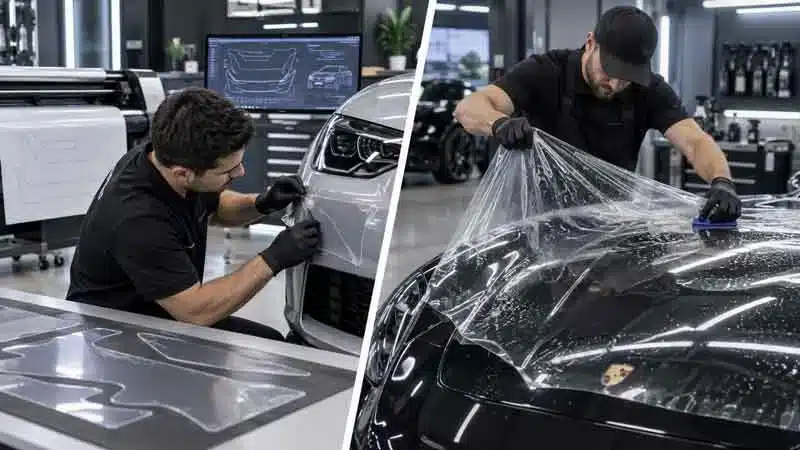
Pre-cut PPF uses a vehicle-specific digital pattern that is cut by a plotter before installation. It usually improves repeatability, reduces on-vehicle trimming and makes material planning easier.
Bulk installation starts with a larger sheet of film that the installer shapes, positions and trims for the individual panel. It gives experienced installers more freedom over coverage and edge wrapping.
Neither method is automatically better for every vehicle.
Many professional shops use a hybrid approach:
Use pre-cut patterns where they improve speed and consistency. Use bulk installation where custom coverage gives a better result.
For distributors and private label buyers, the important question is not only how the film is installed.
It is whether your paint protection film fits the workflow used by your installer network.
Quick Answer: Pre-Cut or Bulk PPF?
The best choice depends on the shop, vehicle and panel.
| Factor | Pre-Cut PPF | Bulk Installation |
|---|---|---|
| Installation speed | Usually faster | Usually slower |
| Repeatability | Strong | Installer dependent |
| Material planning | Easier to control | Depends on installer |
| On-vehicle trimming | Reduced | More common |
| Edge customization | Depends on pattern editing | High flexibility |
| Pattern availability | Required | Not required |
| Modified vehicles | May need adjustment | More flexible |
| Installer cutting skill | Lower dependence | Higher dependence |
| Training scalability | Strong | More difficult |
| Shop standardization | Strong | More craft-dependent |
The real decision is not:
Pre-cut or bulk?
It is:
Which workflow gives the best balance of quality, speed, material use and installer control for this panel?
What Is Pre-Cut PPF?
Pre-cut PPF uses a digital vehicle template.
The typical process is:
Select vehicle model
↓
Choose panel pattern
↓
Edit the pattern if needed
↓
Nest patterns on the roll
↓
Cut with a plotter
↓
Install on the vehicle
The pattern may include:
- hood
- bumper
- fender
- mirror
- door
- rocker panel
- other body sections
A good pattern system can help shops create more consistent coverage from vehicle to vehicle.
This becomes especially useful when the installer repeatedly works on:
- common vehicle models
- dealership programs
- fleets
- installer chains
- standardized packages
What Is Bulk PPF Installation?
Bulk installation starts with an uncut or larger sheet of PPF.
The installer places the film over the panel and creates the final fit during installation.
Depending on the panel and method, the installer may:
- stretch the film
- shape the film
- wrap edges
- trim excess material
- create custom cut lines
Bulk work gives experienced installers more freedom.
It can be especially useful when:
- the vehicle is modified
- the pattern is unavailable
- the pattern does not fit the actual panel well
- deeper edge wrapping is required
- the installer wants custom coverage
But this freedom also puts more responsibility on installer skill.
Pre-Cut vs Bulk PPF: What Is the Real Difference?
The biggest difference is how much of the final shape is decided before the film reaches the vehicle.
Pre-Cut
The pattern decides most of the geometry first.
The installer focuses more on:
- alignment
- positioning
- stretch control
- adhesive contact
- finishing
Bulk
The installer creates more of the final geometry on the vehicle.
This requires more decisions about:
- tension
- trim lines
- edge wrap
- excess material
- panel shape
This means pre-cut is more process-driven.
Bulk is more installer-driven.
Why Professional Shops Use Pre-Cut Patterns
Pre-cut systems can provide several operational advantages.
Faster Repeat Installations
Once a reliable pattern is approved, the shop does not need to recreate every panel from a blank sheet.
This is especially useful for:
- repeated dealer models
- fleet vehicles
- popular local vehicles
More Repeatable Coverage
Patterns help different installers start from the same geometry.
This can improve consistency across a team.
Reduced On-Vehicle Trimming
A pre-cut panel can reduce the amount of cutting performed close to painted surfaces.
This is one of the strongest reasons shops adopt pattern systems.
It does not remove every possible adjustment.
But it can reduce dependence on hand trimming.
Better Material Planning
Digital nesting can help arrange several pieces across the film width.
This can reduce unnecessary waste when the patterns and roll width are managed well.
Easier Training
A new installer still needs strong PPF skills.
But pre-cut patterns remove some of the cutting decisions.
This can make it easier to standardize training across:
- dealer networks
- installer chains
- new staff
Does Pre-Cut PPF Mean No Cutting on the Vehicle?
Not always.
This is an important distinction.
A pre-cut pattern can significantly reduce on-vehicle trimming.
But some installations may still need:
- minor adjustment
- edge modification
- small trimming
- fitment correction
Possible reasons include:
- vehicle variation
- body repair
- aftermarket parts
- trim differences
- pattern preference
- installer edge strategy
Therefore:
Pre-cut should be described as reducing on-vehicle cutting, not guaranteeing zero cutting in every installation.
That is a more realistic expectation.
Can Pre-Cut PPF Wrap Edges?
Yes, depending on the pattern.
Older discussions sometimes simplify pre-cut as:
exposed edges only.
That is no longer accurate.
Modern pattern systems may allow the installer to:
- extend edges
- adjust cut lines
- remove selected relief cuts
- add wrap allowance
This creates three different pattern strategies.
Standard Pre-Cut Pattern
Uses the pattern mostly as supplied.
Best for:
- speed
- consistency
- routine work
Edited Pre-Cut Pattern
The installer modifies the digital pattern before cutting.
This can create:
- longer edges
- deeper wraps
- different cut lines
Full Bulk Installation
The installer has maximum freedom to determine coverage during application.
So the real comparison is often:
standard pre-cut vs edited pre-cut vs bulk
not simply:
pre-cut vs bulk.
Where Pre-Cut Patterns Have Limitations
Pre-cut systems are powerful, but they depend on good data and good setup.
Pattern Availability
The correct pattern must exist.
Rare or very new vehicles may not be available immediately.
Vehicle Variant
The installer needs to confirm:
- model year
- body style
- trim level
- facelift
- regional version
Small vehicle differences can change fitment.
Modified Vehicles
Aftermarket:
- bumpers
- spoilers
- body kits
- trim
can make the original pattern inaccurate.
Previous Body Repair
A repaired panel may not match original factory geometry perfectly.
Pattern Quality
Not all digital patterns provide the same:
- fitment
- coverage
- edge strategy
This is why a pattern should still be inspected before installation.
Plotter Accuracy Matters Too
A good digital pattern can still produce poor fitment if the cutting system is not set up correctly.
Possible factors include:
- plotter calibration
- scale
- material alignment
- cutting pressure
- origin point
- software settings
If a pre-cut kit appears slightly too large or too small, do not immediately assume that the digital pattern is wrong.
The cutting process should also be checked.
For shop owners, this means:
Pattern software does not replace process control.
Why Skilled Installers Still Use Bulk PPF
Bulk installation remains important because it gives the installer maximum control over the panel.
Custom Edge Coverage
An installer can decide exactly how far the film should extend.
This is useful for:
- deep wraps
- hidden edges
- unusual cut lines
Modified Vehicles
Bulk film does not depend on a factory vehicle template.
This makes it practical for:
- custom bodywork
- aftermarket panels
- modified bumpers
Unusual Panel Geometry
Sometimes a skilled installer can create a better result by shaping the film directly on the vehicle.
No Pattern Dependency
Bulk work does not require the shop to wait for a digital template.
This can matter for:
- new models
- rare cars
- regional vehicle variants
What Are the Risks of Bulk Installation?
Bulk installation is not automatically dangerous.
Professional installers can use it safely.
But it places more responsibility on installer skill.
More Trimming Near Paint
The installer may need to trim the film close to the painted panel.
This increases the importance of:
- blade control
- cutting depth
- experience
More Material Allowance
The installer often needs extra film around the panel.
This can increase material usage if the sheet is not planned efficiently.
More Installation Decisions
The installer needs to decide:
- where to stretch
- where to anchor
- where to trim
- how far to wrap
Greater Risk of Excess Tension
If a large bulk sheet is stretched too aggressively, it can create:
- stretch marks
- glue lines
- stored tension
- edge pullback
Our guide to PPF silvering, glue lines and stretch marks explains how excessive stretch and repositioning can create visible installation defects.
Does Bulk PPF Increase Paint-Cutting Risk?
It can increase the amount of cutting performed close to painted surfaces.
That is not the same as saying:
Bulk installation damages paint.
A skilled professional can perform bulk installation safely.
The real difference is:
Bulk installation depends more heavily on installer blade control and trimming experience.
Pre-cut systems reduce that dependence by moving more cutting work to the plotter.
This can be especially useful for shops that need:
- repeatability
- technician training
- lower process variation
Which Method Gives Better Edge Wrapping?
Bulk gives the greatest freedom.
But edited pre-cut patterns can also support effective edge wrapping.
The final result depends on:
- panel geometry
- pattern design
- available wrap allowance
- installer skill
- film stretch
- adhesive behavior
More wrap is not automatically better.
If the installer creates too much tension around the edge, the film may later pull back.
For a deeper explanation, see our guide on why PPF lifts at the edges.
The goal should be:
enough coverage without unnecessary stored tension.
Which Method Uses Less PPF Film?
There is no universal answer.
A well-designed pre-cut workflow can reduce waste because patterns can be nested across the roll.
But actual film use depends on:
- pattern layout
- roll width
- edge extensions
- vehicle mix
- re-cuts
- plotter errors
Bulk installation may use more material because installers need extra film around the panel.
But a skilled bulk installer can also plan material efficiently.
The correct comparison is:
actual film used per completed vehicle
not:
theoretical pattern size.
Which Method Is Faster?
Pre-cut is usually faster when:
- the correct pattern already exists;
- the plotter is calibrated;
- the installer knows the software;
- the pattern fits the vehicle.
Bulk may require more time for:
- positioning
- trimming
- edge decisions
But pre-cut can lose time when:
- the wrong pattern is selected;
- pattern editing is extensive;
- the plotter needs adjustment;
- the pattern needs to be cut again.
For professional shops, installation speed should be measured as:
total workflow time
not only time spent with film on the vehicle.
Why Many Professional Shops Use a Hybrid Workflow
For many shops, the strongest answer is not one method.
It is a hybrid.
Use Pre-Cut When:
- reliable pattern exists;
- model is installed frequently;
- turnaround matters;
- repeat coverage is important;
- several installers need consistency.
Use Bulk When:
- vehicle is modified;
- custom coverage is required;
- pattern fit is uncertain;
- installer wants deeper edge control.
A hybrid shop can decide panel by panel.
For example:
- bumper: pre-cut
- hood: custom bulk
- mirrors: pre-cut
- modified rocker: bulk
This approach uses the strength of each method.
Pre-Cut First Workflow
A pre-cut-first shop normally uses patterns for most panels.
This model can work well for:
- high-volume dealers
- installer chains
- standardized packages
- common vehicles
The main benefits are:
- predictable workflow
- easier training
- consistent coverage
- faster turnaround
Bulk is used only when needed.
Bulk First Workflow
A bulk-first shop relies more heavily on installer craftsmanship.
This may suit:
- custom detailers
- luxury shops
- exotic vehicles
- modified vehicles
The shop gains more control over final coverage.
But skill requirements are higher.
Hybrid Workflow
A hybrid operation keeps both capabilities.
This is often the most flexible model.
The rule can be simple:
Use the pattern when it improves efficiency without reducing the desired result. Use bulk when the panel genuinely benefits from custom coverage.
Pre-Cut vs Bulk for Different PPF Businesses
Different business models can favor different workflows.
| Business Model | Likely Direction | Main Reason |
|---|---|---|
| High-volume dealer program | Pre-cut-heavy | Speed and repeatability |
| Installer chain | Pre-cut / hybrid | Standardized training |
| Boutique luxury shop | Hybrid / bulk | Custom coverage |
| Fleet program | Pre-cut-heavy | Repeated models |
| Modified vehicle specialist | Bulk / hybrid | Pattern limitations |
| New installer team | Pre-cut-supported | Easier standardization |
These are not fixed rules.
They are operating directions.
Why Pre-Cut Works Well for Fleet Programs
Fleet programs often repeat the same:
- vehicle model
- panel
- coverage package
This makes pre-cut patterns attractive.
The distributor or installer can create a repeatable program for:
- front bumper
- hood
- mirrors
- high-wear zones
This improves:
- quoting
- material planning
- installation consistency
For fleet buyers, see our PPF for fleet vehicles application guidance.
Should a Distributor Sell Bulk Rolls or Pre-Cut Kits?
This is a different question from installer technique.
It is an inventory decision.
Bulk Roll Supply
Advantages include:
- fewer SKUs
- broad vehicle coverage
- easier inventory management
- local pattern cutting
- local custom installation
This is usually easier for international distributors.
Pre-Cut Kit Supply
Advantages can include:
- vehicle-specific packaging
- faster installer workflow
- value-added product positioning
But inventory becomes more complex.
The distributor may need to manage:
- vehicle make
- model
- year
- body style
- panel
- kit version
This can create SKU expansion.
Why Pre-Cut Kit Inventory Can Become Complicated
One bulk PPF roll can serve many vehicles.
One pre-cut kit serves a much narrower application.
For example, the distributor may need separate inventory for:
- Model A bumper
- Model A hood
- Model B bumper
- Model B hood
- different model years
Vehicle facelifts can also make older kits less useful.
This is why pre-cut kit supply should be linked to real demand.
A Practical Roll-to-Pre-Cut Strategy
For many distributors, a phased strategy makes sense.
Phase 1: Bulk Roll Supply
Build:
- installer network
- product familiarity
- market demand
Phase 2: Local Pattern Workflow
Support installers using:
- plotters
- cutting software
Phase 3: Selected Pre-Cut Programs
Develop pre-cut supply for:
- high-volume models
- fleet platforms
- repeated specialty applications
This keeps inventory more controlled.
FUNO already supports both roll and selected pre-cut directions in specialty categories such as headlight protection film and windshield protection film.
How Installation Method Can Affect PPF Product Selection
The same PPF may be used in both workflows.
But installer priorities can differ.
Pattern-Heavy Shop
May place more emphasis on:
- repeatable tack
- positioning
- plotter handling
- consistent edge behavior
Bulk-Focused Shop
May place more emphasis on:
- stretch
- conformability
- recovery
- longer working time
- edge wrapping
This is why distributors should tell suppliers how their installer network works.
Adhesive Behavior Still Matters
Pre-cut does not remove the need for good adhesive performance.
Installers still need:
- manageable tack
- repositionability
- clean squeegee work
- stable edges
Bulk installers may be even more sensitive to working time because larger pieces are being controlled at once.
Our PPF adhesive guide explains how tack, repositionability and final bond should be evaluated together.
Does PPF Thickness Change Which Method Is Better?
Not directly.
A thicker PPF does not automatically require bulk installation.
A thinner PPF does not automatically work better as pre-cut.
The installer should consider:
- material
- thickness
- stretch
- adhesive
- panel shape
- pattern design
Our PPF thickness guide explains why thickness should always be evaluated as part of the full film system.
How Should Distributors Compare Pre-Cut and Bulk Workflows?
Do not make the decision from theory.
Run a real shop comparison.
Step 1: Choose the Same Vehicle Model
Use a common model that matters in your market.
Step 2: Select Several Panels
Include:
- hood
- bumper
- mirror
Step 3: Use the Same Film
This removes film quality as a variable.
Step 4: Record Total Film Used
Track actual roll consumption.
Step 5: Record Total Time
Include:
- pattern preparation
- cutting
- installation
- trimming
- rework
Step 6: Record Edge Result
Check:
- exposed edges
- wrapped edges
- alignment
Step 7: Record Rework
Did the panel need:
- re-cut
- extra trimming
- extra stretch
- edge correction
Step 8: Ask the Installer
Which method was:
- faster
- easier
- more predictable
- visually cleaner
This produces real operating data.
A Simple Workflow Comparison Record
A shop can use a basic table.
| Metric | Pre-Cut | Bulk |
|---|---|---|
| Film used | Record | Record |
| Setup time | Record | Record |
| Installation time | Record | Record |
| Trimming time | Record | Record |
| Rework | Record | Record |
| Edge result | Record | Record |
| Installer rating | Record | Record |
There is no universal winner.
The data should reflect your shop.
How Should Private Label Buyers Specify Installation Workflow?
A private label buyer should not send only:
“We need 7.5 mil TPU PPF.”
Also explain how the product will be used.
Useful information includes:
- pre-cut, bulk or hybrid workflow
- plotter usage
- installer experience
- common vehicle types
- edge wrapping preference
- market segment
- high-volume dealer or custom shop
- target roll width
This gives the manufacturer more useful context.
How FUNO Approaches Installer Workflow
FUNO supplies PPF for professional installer and distributor channels.
We do not assume every installer uses the same installation method.
Product evaluation should consider:
- tack
- repositionability
- stretch
- conformability
- thickness
- edge behavior
- installer feedback
These properties matter differently depending on whether the buyer mainly uses:
- pre-cut
- bulk
- hybrid installation
For distributors, the correct product is not only the film with the best specification on paper.
It is the film that fits the way your installers actually work.
Pre-Cut Does Not Replace Installer Skill
Pattern software can help with:
- accuracy
- repeatability
- material planning
But it does not eliminate the need for:
- surface preparation
- solution control
- stretch control
- adhesive management
- edge finishing
A poor installation does not become professional simply because a plotter was used.
Bulk Does Not Automatically Mean Premium
The opposite mistake also happens.
Some shops describe bulk installation as automatically more premium.
That is not always true.
A poorly planned bulk installation can create:
- excess film waste
- excessive stretch
- poor cuts
- unstable edges
The quality depends on the installer and the panel.
The method itself is not the quality grade.
FAQ
Is pre-cut PPF better than bulk installation?
Not always.
Pre-cut usually improves speed and repeatability, while bulk gives experienced installers more control over custom coverage.
Does pre-cut PPF require cutting on the vehicle?
It can greatly reduce on-vehicle trimming, but minor adjustments may still be needed depending on the pattern and vehicle.
Can pre-cut PPF wrap edges?
Yes.
Many modern pattern workflows allow edge extensions or pattern editing.
Bulk still gives the installer the greatest freedom.
Does bulk PPF use more film?
It can, because more material may be required around the panel.
However, actual consumption depends on installer planning, vehicle geometry and waste.
Is pre-cut PPF faster?
Usually, when a reliable pattern is available and the shop has an efficient plotter workflow.
But pattern editing, setup and re-cuts also take time.
Is bulk installation dangerous for paint?
Not automatically.
Professional installers can trim bulk PPF safely.
But bulk work places more responsibility on blade control because more cutting may occur near painted surfaces.
Which method is better for new installers?
Pre-cut patterns can make training easier to standardize, but new installers still need to learn film handling, stretch, tack, solution control and edge finishing.
Which method is better for distributors?
Many distributors benefit from keeping bulk rolls as core inventory while supporting local pre-cut workflows or selected pre-cut programs for high-volume applications.
Pre-Cut and Bulk Are Tools, Not Quality Grades
Pre-cut PPF and bulk installation solve different workflow problems.
Pre-cut helps with:
speed + repeatability + reduced trimming + material planning
Bulk helps with:
custom coverage + edge freedom + unusual vehicles + installer control
Modern pattern editing has reduced the gap between the two.
That is why many professional shops use both.
For installers, the right choice should be made panel by panel.
For shop owners, it should be based on:
- total installation time
- material use
- training
- rework
- finished quality
For distributors and private label buyers, the question should go one step further:
Which installation workflow does our installer network actually use, and does our PPF product line support it well?
FUNO supports distributors, installer networks and private label buyers with product selection, sample evaluation, specification alignment and repeat supply through our PPF OEM and private label service.
The strongest professional workflow is not the one that always uses pre-cut or always uses bulk.
It is the one that uses the right method for the panel, installer and business model.
Related Posts

Contact FUNO
Tell us your target market, product category, preferred specification, estimated purchasing volume, and whether you need standard or private label supply.
FUNO can help you narrow suitable film options, sample requirements, packaging needs, and the next step toward bulk purchasing.