
Temperature can change the way paint protection film feels from the moment it touches the panel.
In colder conditions, a PPF may feel firmer, conform more slowly and develop tack differently. In hotter conditions, the film may become softer, installation solution can evaporate faster and the adhesive may grab sooner.
This is why there is no useful universal answer such as:
“All PPF should be installed at exactly 23°C.”
Professional manufacturers may specify a minimum application temperature, a recommended installation range, or an optimal working range for a particular film.
For installers and distributors, the correct approach is:
Check the exact PPF specification, measure both workshop and panel temperature, and test the film under realistic installation conditions.
What Is the Best Temperature for PPF Installation?
Most professional wet-install PPF is easier to work with in a moderate and stable indoor environment.
But the exact temperature range depends on the product.
A paint protection film may have its own:
- minimum application temperature;
- recommended application range;
- preferred working range.
These terms are not identical.
For example:
Minimum Application Temperature
This normally tells you the lowest stated temperature at which the product should be applied under the manufacturer’s conditions.
It does not necessarily mean:
“This is the easiest temperature for installation.”
Recommended Range
This gives installers a broader working window.
Optimal Working Range
Where supplied, this normally describes conditions in which the film is expected to be easier and more predictable to install.
For FUNO products, use the current guidance for the exact film series rather than applying one internet temperature range to every PPF.
Why Is There No Universal PPF Installation Temperature?
PPF products are not identical.
Different films may use different:
- TPU materials;
- film thicknesses;
- topcoats;
- adhesive systems;
- liners;
- product constructions.
Two products can therefore respond differently in the same workshop.
Temperature can change several installation properties at the same time.
| Temperature-Related Property | What the Installer May Notice |
|---|---|
| Adhesive tack | Faster or slower initial grab |
| Repositionability | Longer or shorter working time |
| Film flexibility | Easier or harder conformability |
| Stretch | Softer or firmer film feel |
| Slip solution | Faster or slower evaporation |
| Water evacuation | Different settling behavior |
| Edge stability | Different initial edge hold |
| Installation speed | More or less rework |
This is why temperature should be considered as part of the complete installation system.
Ambient Temperature vs Panel Temperature: Which Matters More?
Both matter.
This is one of the most important parts of professional PPF installation.
Ambient Temperature
This is the temperature of the workshop air.
It affects:
- the film;
- installation solution;
- installer working conditions.
Panel Temperature
This is the actual surface temperature of:
- hood;
- bumper;
- door;
- fender;
- mirror.
And it may be very different from the room temperature.
Example: A Hot Vehicle
A black vehicle may enter a 24°C workshop after sitting in direct sun.
The room is comfortable.
The panel may still be much hotter.
If installation begins immediately, the installer may notice:
- faster solution evaporation;
- stronger early grab;
- shorter repositioning time;
- softer film.
Example: A Cold Vehicle
The opposite can happen in winter.
The workshop may already be warm, but a vehicle just brought indoors can still have very cold panels.
The PPF may then behave as if it is being installed in a colder environment.
The practical rule is:
Do not judge installation conditions only from the wall thermostat.
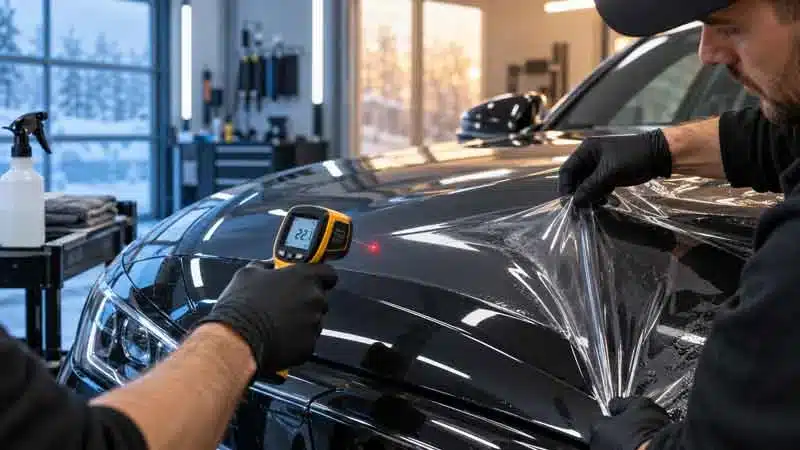
When temperature matters, measure the actual panel.
Should the Vehicle and PPF Acclimate Before Installation?
In many situations, yes.
If:
- the PPF came from a cold warehouse;
- the vehicle came from outdoor winter conditions;
- the vehicle was sitting in strong sun;
- the workshop temperature is very different from transport conditions,
allowing the material and vehicle to stabilize can make installation more predictable.
This is especially useful when the temperature difference is large.
The goal is not to “heat activate” the adhesive.
The goal is to bring:
- film;
- panel;
- installation environment
into suitable working conditions.
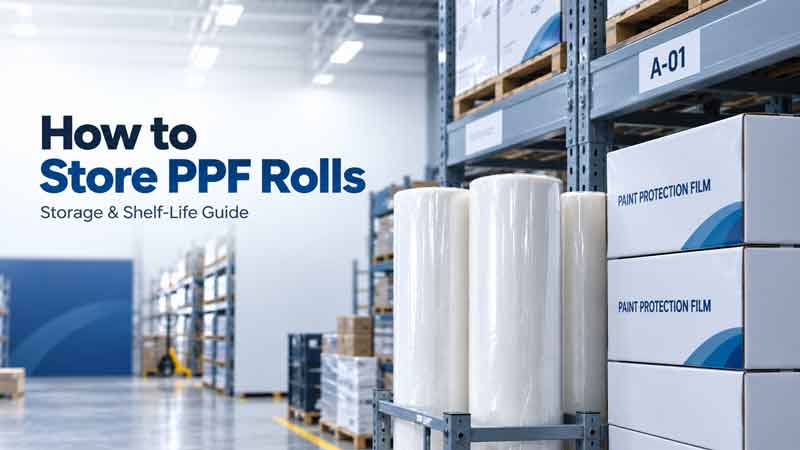
For roll-storage conditions before installation, see our PPF roll storage and shelf-life guide.
What Happens When PPF Is Installed Too Cold?
Cold conditions can change the way both the film and adhesive behave.
The exact response varies by product, but installers may notice several common effects.
The Film Can Feel Firmer
TPU becomes harder to conform when it is colder.
On a flat hood, this may not be a major issue.
On:
- bumper corners;
- mirrors;
- compound curves,
the difference can become much more noticeable.
Stretch Can Feel Less Natural
A colder film may require more effort to conform.
This creates a risk that the installer compensates by pulling harder.
That can leave:
- stored tension;
- poor edge behavior;
- uneven stretch.
Tack May Develop Differently
Pressure-sensitive adhesive behavior is temperature-dependent.
In cooler conditions, the film may feel less responsive during initial bonding.
This does not mean the adhesive “stops working.”
It means the installation feel can change.
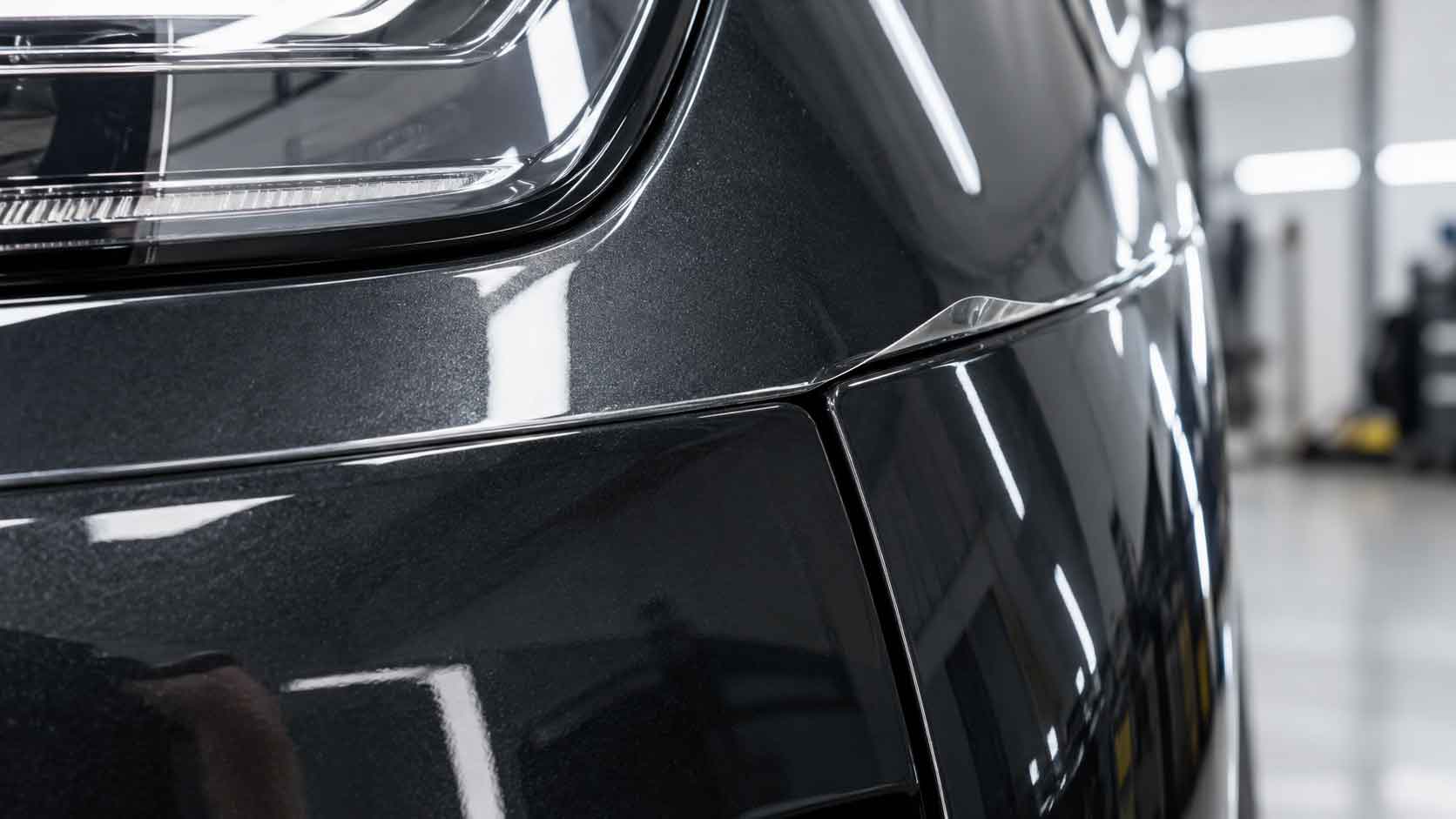
Edge Finishing May Become More Difficult
Edges already combine:
- limited contact area;
- film tension;
- complex geometry.
If adhesive response is less predictable, the edge may require more attention.
This is one reason temperature should be checked when diagnosing PPF edge lifting.
Can You Install PPF in Cold Weather?
The important question is not:
“Is it winter outside?”
It is:
What are the actual installation conditions inside the workshop and on the vehicle panel?
Professional PPF installation normally takes place in a controlled indoor environment.
A cold climate does not automatically prevent PPF installation.
The installer should instead manage:
- workshop temperature;
- vehicle acclimation;
- panel temperature;
- product-specific minimum application temperature.
If the exact film is below its stated application condition, forcing the installation is not a good solution.
What Happens When PPF Is Installed Too Hot?
High temperature creates a different set of problems.
The film may become easier to stretch, but easier does not always mean better.
Slip Solution Can Evaporate Faster
During wet application, solution gives the installer time to:
- position;
- slide;
- align;
- squeegee the film.
A hot panel can shorten this working window.
Adhesive May Grab Earlier
Depending on the PPF system, hotter conditions may make initial tack feel more active.
The installer may have less time to make large corrections.
Large Panels Become Harder to Keep Uniformly Wet
On a hood or large fender, one area may begin drying while another is still being positioned.
This can increase the chance of:
- uneven tack;
- repeated lifting;
- adhesive marks.
Film Can Feel Very Soft
Soft film may conform easily.
But excessive softness can also make it easier to:
- overstretch;
- create uneven tension;
- distort the film.
The goal is not to make the PPF as warm and soft as possible.
The goal is predictable handling.
Can You Install PPF in Hot Weather?
Yes, if the actual working conditions remain within the product’s installation guidance.
But installers should pay attention to panel temperature.
A workshop may be air-conditioned while the car surface is still hot.
This is particularly important with:
- black paint;
- dark paint;
- vehicles recently parked outdoors.
Before installation, stabilize the vehicle when necessary.
Do not assume that a comfortable room means a comfortable panel.
How Temperature Changes PPF Adhesive Tack
Initial tack describes how quickly the adhesive grabs when the film first contacts the panel.
Temperature can change how this feels.
In Cooler Conditions
The installer may notice:
- slower initial grab;
- more difficult anchoring;
- different edge response.
In Warmer Conditions
The installer may experience:
- faster grab;
- shorter repositioning time;
- less forgiveness after contact.
The exact behavior depends on the adhesive system.
This is why distributors should not evaluate PPF adhesive only at one workshop temperature.
For a full explanation of initial tack, repositionability and peel adhesion, see our PPF adhesive guide.
Temperature and Repositionability
Repositionability is one of the most practical properties installers notice when switching PPF suppliers.
A film may feel:
- easy to slide at one temperature;
- much more aggressive at another.
This can change:
- hood installation speed;
- bumper alignment;
- pattern positioning;
- installer confidence.
For professional distributor evaluation, repositionability should be tested within the real working conditions of the target market.
Do not approve a sample simply because it performs well in one comfortable showroom.
How Temperature Affects Stretch and Conformability
PPF needs enough flexibility to follow vehicle geometry.
Temperature affects how easily that happens.
Lower Temperature
Film may feel:
- firmer;
- less conformable;
- harder to distribute over compound curves.
Higher Temperature
Film may feel:
- softer;
- easier to shape;
- easier to overstretch.
This creates an important balance.
Installers should not solve a cold-film problem by simply pulling harder.
They also should not use excessive heat to make every difficult area extremely soft.
The film should remain within the product’s correct application process.
Why Temperature Can Affect Edge Stability
Edge stability is the result of several forces.
The adhesive must create enough contact to hold the film.
At the same time, the film may be trying to recover from stretch.
Temperature affects both sides of this balance.
A cooler film may:
- hold more stiffness;
- require more controlled conforming.
A hotter film may:
- stretch more easily;
- allow too much tension to be introduced.
This means edge problems should not be diagnosed only as:
“weak adhesive.”
Temperature, tension and finishing all matter.
How Temperature Changes Slip Solution Behavior
PPF wet installation depends on controlled liquid management.
Slip solution allows the film to move before final squeegee work.
Temperature can affect how quickly the liquid:
- evaporates;
- moves;
- leaves the panel.
Hot Panel
Solution can dry faster.
This can reduce working time.
Cool Panel
Moisture may remain longer in the installation interface.
This can change settling time.
The important point is:
Do not treat the slip-solution formula as independent from installation conditions.
The correct mixture and process should follow the PPF manufacturer’s current installation guidance.
A solution method that works well for one film in one climate may not feel identical with another film.
Should Installers Change Slip Solution With Temperature?
Sometimes the installation method may need adjustment.
However, there should not be one universal rule such as:
“Add exactly X% more soap above 30°C.”
Different manufacturers and installers use different systems.
For professional use:
- follow the product guidance;
- change one variable at a time;
- document what works;
- avoid uncontrolled formulas.
For distributors operating installer networks, standardized installation guidance can reduce inconsistent feedback.
Does Humidity Matter During PPF Installation?
Humidity can influence the wet-installation environment, but it should not be confused with temperature.
High or low humidity may influence:
- evaporation;
- condensation risk;
- drying;
- settling.
For example, a cold panel moved into a warm, humid room may develop surface moisture.
That surface should not be treated as ready for film installation until conditions are appropriate.
There is no useful universal humidity percentage that should be applied to every PPF.
The exact product instructions should remain the reference.
Can Warm Water Help PPF Installation?
Some PPF systems allow warm water as part of installation on difficult curves or cooler conditions.
Warm water may help with:
- film flexibility;
- conformability;
- local working behavior.
But this does not mean:
“All PPF should be installed with hot water.”
And it does not mean:
“Heat is required to activate all PPF adhesive.”
Professional PPF normally uses pressure-sensitive adhesive.
Water temperature, heat use and finishing methods should follow the exact film guidance.
Heat Gun vs Controlled Installation Temperature
A heat gun is not a replacement for proper workshop temperature.
These are two different things.
Workshop Temperature
Controls the general:
- film;
- vehicle;
- adhesive;
- solution environment.
Local Heat
May be used by trained installers for specific:
- curves;
- shaping;
- finishing steps
when the film system permits it.
Trying to fix an entire cold installation by repeatedly heating small areas can create uneven film behavior.
Good installation starts with suitable overall conditions.
Application Temperature vs Service Temperature
These values should never be confused.
Application Temperature
Describes the temperature condition required or recommended when the film is installed.
Service Temperature
Describes the temperature range the installed product is designed to tolerate under its specified service conditions.
The service range may be much wider.
This does not mean the film can be installed anywhere within that full service range.
A product that survives freezing temperatures after installation may still require a much warmer environment during application.
For buyers comparing these values, see our PPF Technical Data Sheet Guide.
Application Temperature vs Storage Temperature
Storage temperature is another separate specification.
It applies while the PPF is:
- rolled;
- packed;
- waiting in inventory.
Application temperature applies during installation.
Do not assume:
“The warehouse can store this film at that temperature, so installation is also suitable there.”
Each specification has a different purpose.
Why Installers Should Measure Panel Temperature
A simple surface-temperature measurement can make troubleshooting more objective.
Instead of saying:
“The shop feels warm enough.”
the installer can record:
- ambient temperature;
- panel temperature.
This is especially useful when:
- vehicle arrived from outside;
- black paint has been in the sun;
- winter shop conditions vary;
- installer is comparing different samples.
For distributor sample testing, recorded conditions create much better feedback than:
“Sample A was difficult.”
How Should Distributors Test PPF Across Different Temperatures?
This is where temperature becomes a procurement issue.
A distributor should not approve PPF at one comfortable temperature and assume the product will feel identical everywhere.
A practical test can keep most variables consistent.
Use:
- same film series;
- same installer;
- same panel type;
- same installation solution;
- same installation method.
Then evaluate the film under relevant controlled conditions.
Record:
| Test Item | Cooler Condition | Moderate Condition | Warmer Condition |
|---|---|---|---|
| Initial tack | Record result | Record result | Record result |
| Repositionability | Record result | Record result | Record result |
| Film flexibility | Record result | Record result | Record result |
| Stretch control | Record result | Record result | Record result |
| Solution working time | Record result | Record result | Record result |
| Edge finishing | Record result | Record result | Record result |
| Rework required | Record result | Record result | Record result |
Do not use arbitrary cold and hot temperatures.
Choose test points based on:
- the product’s stated application range;
- the climate of the actual market;
- installer workshop conditions.
Our PPF sample testing guide explains how to build a broader sample evaluation before placing a bulk order.
Why Distributor Test Conditions Should Match the Market
A distributor serving one region may need a different approval program from another.
Cold-Climate Installer Network
Pay more attention to:
- film flexibility;
- tack development;
- edge finishing;
- workshop control;
- vehicle acclimation.
Hot-Climate Installer Network
Pay more attention to:
- working time;
- premature grab;
- slip-solution evaporation;
- large-panel positioning;
- overstretch.
Mixed-Climate Network
The key question becomes:
How predictable is the product across the installer conditions we actually face?
This does not mean one film must feel exactly the same at every temperature.
It means the differences should be manageable and understood.
Do Not Confuse Installation Climate With Outdoor Durability
Installation temperature is about:
how the film behaves while it is being applied.
Outdoor durability is about:
how the installed film performs during long-term service.
These are separate questions.
A product may install well in a controlled workshop and later be used in:
- very hot;
- very cold;
- high-UV
conditions.
Long-term weathering and anti-yellowing should be evaluated separately from installation temperature.
How Should Private Label Buyers Specify Installation Temperature Requirements?
Avoid an RFQ such as:
“Film must work in all temperatures.”
That is too vague.
A stronger OEM brief should define:
Target Market
Where will the product be sold?
Installer Environment
Are shops generally:
- climate controlled;
- cold in winter;
- hot in summer?
Existing Reference Film
What product are installers already using?
Required Installation Behavior
Do installers prefer:
- easier slide;
- faster grab;
- wider repositioning window?
Critical Panels
Are customers frequently installing:
- large hoods;
- bumpers;
- mirrors;
- complex sports cars?
Temperature-Related Complaints
Does the current product have problems with:
- winter edge work;
- summer tack;
- fast drying;
- repositioning?
This gives the factory much more useful information than asking only for:
“good adhesive.”
How FUNO Evaluates Temperature-Dependent Installation Behavior
FUNO is the film brand of Hebei Fengao New Materials Co., Ltd.
For professional PPF evaluation, we consider the relationship between:
- film material;
- thickness;
- adhesive;
- topcoat;
- initial tack;
- repositionability;
- stretch;
- conformability;
- edge behavior;
- installer feedback.
Temperature is part of this evaluation because it changes how these properties are experienced during installation.
For distributor and private label projects, we recommend confirming the installation guidance for the exact FUNO film series.
We do not recommend applying one temperature range to every:
- gloss;
- matte;
- satin;
- colored;
- specialty PPF.
The exact product should remain the reference.
Temperature Consistency Matters During Sample Approval
If Supplier A is tested at one temperature and Supplier B at another, the comparison is weaker.
For professional sample approval:
same panel
same installer
same temperature
same solution
same evaluation method
should be used whenever possible.
This helps distributors identify real product differences instead of environmental differences.
What If a New Batch Suddenly Feels Different?
Temperature should be checked before concluding that a new batch has changed.
Ask:
- Was the workshop temperature similar?
- Was panel temperature similar?
- Did the vehicle come directly from outside?
- Was the same solution used?
- Was the roll stored correctly?
- Was the same installer involved?
If conditions were controlled and several rolls from the same batch still behave differently, then batch consistency deserves further investigation.
This creates a more reliable supplier-quality discussion.
Common Temperature Mistakes During PPF Installation
Mistake 1: Looking Only at Room Temperature
The panel may still be much hotter or colder.
Mistake 2: Installing Immediately After Moving the Car Indoors
The vehicle may need time to stabilize.
Mistake 3: Pulling Harder Because the Film Feels Cold
This can create unnecessary stored tension.
Mistake 4: Using More Heat to Solve Every Problem
Local heat does not replace correct overall installation conditions.
Mistake 5: Assuming Every PPF Has the Same Temperature Range
Different product series can use different specifications.
Mistake 6: Comparing Two Samples Under Different Conditions
Environmental differences can be mistaken for product differences.
FAQ
What is the best temperature for PPF installation?
There is no single temperature that applies to every PPF.
Professional films are generally easier to install in a moderate, controlled environment, but the exact application or optimal working range should come from the specific product guidance.
Can PPF be installed in cold weather?
Yes, if the vehicle and workshop are brought into suitable installation conditions within the film’s stated application range.
Outdoor winter temperature alone does not determine whether indoor installation is possible.
What happens if PPF is installed too cold?
The film may feel firmer, stretch may become harder to control and adhesive response or edge finishing may become less predictable.
The exact behavior depends on the film.
Can PPF be installed when it is very hot?
Installation may still be possible within the product’s approved range, but hot panels can shorten working time, increase solution evaporation and change tack.
Measure the panel, not just the room.
Does panel temperature matter during PPF installation?
Yes.
A car recently exposed to sun or winter cold may have a surface temperature very different from the workshop air.
Does heat activate PPF adhesive?
Professional PPF commonly uses pressure-sensitive adhesive.
Temperature can change adhesive behavior, but that does not mean all PPF adhesive requires heat activation.
Is PPF service temperature the same as installation temperature?
No.
Service temperature describes conditions after installation.
Application temperature describes conditions while installing the film.
Should distributors test PPF at different temperatures?
If their installer network works in different climates, yes.
Testing controlled temperature conditions can reveal differences in tack, repositionability, stretch, solution behavior and edge finishing.
Temperature Is Part of PPF Performance, Not Just Workshop Comfort
PPF installation temperature affects much more than whether the installer feels comfortable.
It can change:
tack
repositionability
film flexibility
stretch
solution working time
edge stability
installer rework
The most important rule is not to memorize one universal temperature.
Instead:
Check the exact product guidance.
Measure both ambient and panel temperature.
Allow the film and vehicle to stabilize when necessary.
Compare samples under controlled conditions.
Test products under conditions relevant to your market.
For distributors and private label buyers, the question should not be:
“Does this PPF install well at 23°C?”
The better question is:
“Does this PPF remain predictable across the real installation conditions our installer network will face?”
FUNO supports distributors, importer networks and private label brands with product selection, sample evaluation, specification alignment and repeat supply through our PPF OEM and private label service.
A professional PPF program should combine the right film with the right installation conditions.
That is how technical specifications become predictable installer performance.
Related Posts

Contact FUNO
Tell us your target market, product category, preferred specification, estimated purchasing volume, and whether you need standard or private label supply.
FUNO can help you narrow suitable film options, sample requirements, packaging needs, and the next step toward bulk purchasing.