
Yes, PPF can sometimes be installed over a professionally repainted panel.
But a repainted panel usually carries more uncertainty than sound OEM paint.
Before installation, the paint should be:
- fully cured;
- properly bonded;
- free from peeling, cracking or blistering;
- clean and free from wax, silicone or coating residue.
The installer should also confirm the applicable PPF warranty and explain that future removal risk may be higher on non-OEM paint.
A successful installation today does not guarantee risk-free removal years later.
For installers, distributors and private label brands, the key question is not simply:
“Can PPF stick to this repaint?”
It is:
“Is this repainted paint stable enough to accept an adhesive film now and later survive professional removal?”
Quick Answer: Repainted Panels Need More Inspection
The safest way to think about PPF over repainted panels is to separate the paint condition into four groups.
| Panel Condition | PPF Direction | Main Action |
|---|---|---|
| Sound OEM paint | Normally suitable | Standard professional preparation |
| Professionally repainted, fully cured and stable | Sometimes suitable | Inspect, confirm history and explain removal risk |
| Fresh repaint or cure time unknown | Delay | Confirm paint-system cure guidance |
| Peeling, cracking, blistering or unstable repair | Not suitable as-is | Repair the paint first |
PPF should not be used as a way to hold weak paint together.
PPF does not strengthen weak paint. It only bonds to the surface that is already there.
Why Repainted Panels Are Different From OEM Paint
OEM paint and repair paint can both produce excellent finishes.
The difference is process consistency.
Factory automotive paint is applied through a highly controlled production process.
A repaired panel may depend on more variables such as:
- sanding;
- primer;
- filler;
- basecoat;
- clearcoat;
- reducer;
- hardener;
- spray technique;
- film thickness;
- drying or baking conditions.
A professional body shop can produce a very strong repair.
But the PPF installer may not know the full repair history.
That uncertainty is the main reason repainted panels should be treated differently.
Repainted does not automatically mean poor paint.
It means:
The substrate history needs to be confirmed before adding another adhesive layer.
Dry Paint vs Fully Cured Paint: What Is the Difference?
These terms are often confused.
Dry to Touch
The surface no longer feels wet or sticky.
This does not mean it is ready for PPF.
Ready for Handling
The panel may be safe to:
- assemble;
- move;
- deliver.
Again, this does not automatically mean it is ready for adhesive film.
Polishable
Some refinish systems may allow polishing before full cure.
That is still a different question from PPF installation.
Fully Cured
The paint has reached the cure condition defined by the refinish system under its stated process.
Properly Bonded
This is another separate issue.
A paint layer can be cured but still have poor adhesion between:
- clearcoat and basecoat;
- basecoat and primer;
- primer and substrate.
So:
Dry is not the same as cured, and cured is not automatically the same as well bonded.
This distinction is central to PPF risk.
How Long Should You Wait After Repainting Before Installing PPF?
There is no single waiting period that applies to every automotive repaint.
Major PPF brands often publish a waiting recommendation around 30 days for fresh paint so the new coating has time to cure and outgas.
That is useful guidance.
But it should not be treated as a universal paint-cure rule.
Actual cure time can vary with:
- refinish system;
- clearcoat chemistry;
- hardener;
- reducer;
- film build;
- ambient temperature;
- bake cycle;
- air-dry process.
The correct process is:
- identify the paint or clearcoat system if possible;
- confirm the repaint date;
- check body-shop or paint-manufacturer cure guidance;
- check the PPF manufacturer’s substrate and warranty requirements;
- do not shorten the waiting period only to meet an appointment.
If the paint information cannot be confirmed, the risk remains higher.
Why “30 Days” Is a Guideline, Not a Paint-Cure Test
A calendar does not inspect the paint.
Two panels repainted on the same day may have different cure conditions because they used different:
- products;
- temperatures;
- film builds;
- booth cycles.
This is why “30 days” should be treated as a common waiting reference, not proof that every repaint is ready.
Some professional PPF brands use approximately 30 days as a fresh-paint waiting recommendation.
But automotive refinish technical data can define different cure times for different coating systems.
The better question is:
Has this exact paint system completed its required cure under the actual repair process?
That is more reliable than counting days alone.
Why Fresh Paint Needs Extra Caution
Fresh automotive coatings continue developing after the panel first becomes touch-dry.
Depending on the system, this may involve:
- solvent release;
- chemical cross-linking;
- hardness development.
Installing adhesive film too early can increase uncertainty around:
- adhesion;
- trapped volatile material;
- bubbling or blistering concerns;
- future removal.
The risk does not come from one single mechanism in every paint system.
That is why the PPF installer should not make the cure decision alone when the body shop can provide better information.
What Should Be Checked Before Installing PPF on a Repainted Panel?
This should be a structured inspection.
1. Confirm Which Panel Was Repainted
Do not assume the entire vehicle is original paint.
Ask:
- Which panel?
- Was only one section repaired?
- Was the whole panel resprayed?
2. Ask When It Was Repainted
Record the repaint date.
If the date is unknown, the installer has less information about cure status.
3. Ask Why It Was Repainted
Was the reason:
- collision repair;
- scratch repair;
- cosmetic respray;
- clearcoat failure?
Previous clearcoat failure is especially important.
4. Ask Which Body Shop Performed the Repair
This may allow the customer to confirm:
- paint system;
- cure process;
- bake cycle.
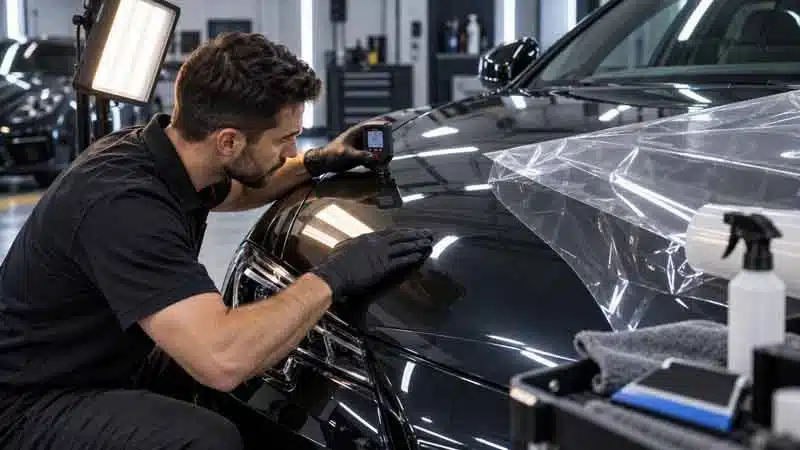
5. Inspect the Surface
Look for:
- peeling;
- cracking;
- blistering;
- soft paint;
- poor clearcoat edges;
- repair lines;
- sanding marks;
- dust nibs;
- visible texture problems.
If the paint already looks unstable, PPF should not be used as a repair.
What Surface Conditions Should Make an Installer Delay the Job?
Delay the installation if:
- repaint date is very recent;
- cure status cannot be confirmed;
- paint still feels unusually soft;
- visible defects are developing;
- body shop recommends more cure time.
The correct decision may simply be:
Wait.
A delayed installation is usually less expensive than a future paint claim.
When Should an Installer Decline the Job?
PPF installation should not proceed over clearly unstable paint.
Examples include:
- peeling clearcoat;
- cracking paint;
- blistering;
- flaking edges;
- previous adhesion failure;
- paint lifting from normal masking or handling;
- poorly repaired damage.
In these situations, the paint problem should be repaired first.
PPF is a protective film.
It is not a structural repair for failing coating.
Can a Paint Thickness Gauge Confirm the Panel Is Safe for PPF?
No.
A paint thickness gauge can be useful.
It may help identify:
- repaint history;
- panel-to-panel thickness differences;
- unusually heavy paint build.
But it does not directly measure:
- paint adhesion;
- cure quality;
- clearcoat-to-basecoat bond.
So a thickness gauge is a diagnostic clue.
It is not a certificate that says:
“Safe for PPF.”
This distinction matters.
Should the Installer Perform an Adhesion Test on the Paint?
Not as an improvised destructive test.
Do not assume that pulling aggressive tape on a customer’s painted panel is a reliable or harmless way to “prove” paint strength.
If paint adhesion is genuinely uncertain, the better approach is to involve:
- the body shop;
- the refinish paint supplier;
- a qualified coating professional.
The PPF installer should not damage the substrate while trying to test it.
Does Ceramic Coating Matter on a Repainted Panel?
Yes.
If the repaired panel has already received:
- ceramic coating;
- wax;
- sealant;
- silicone-rich polish,
surface preparation becomes another issue.
These products can interfere with PPF adhesion.
The coating question should be handled separately from repaint cure.
For a full explanation, see our guide on installing PPF over ceramic coating.
The basic rule is:
Cured paint still needs a clean, suitable surface before PPF installation.
Will PPF Hide Repaint Defects?
Not reliably.
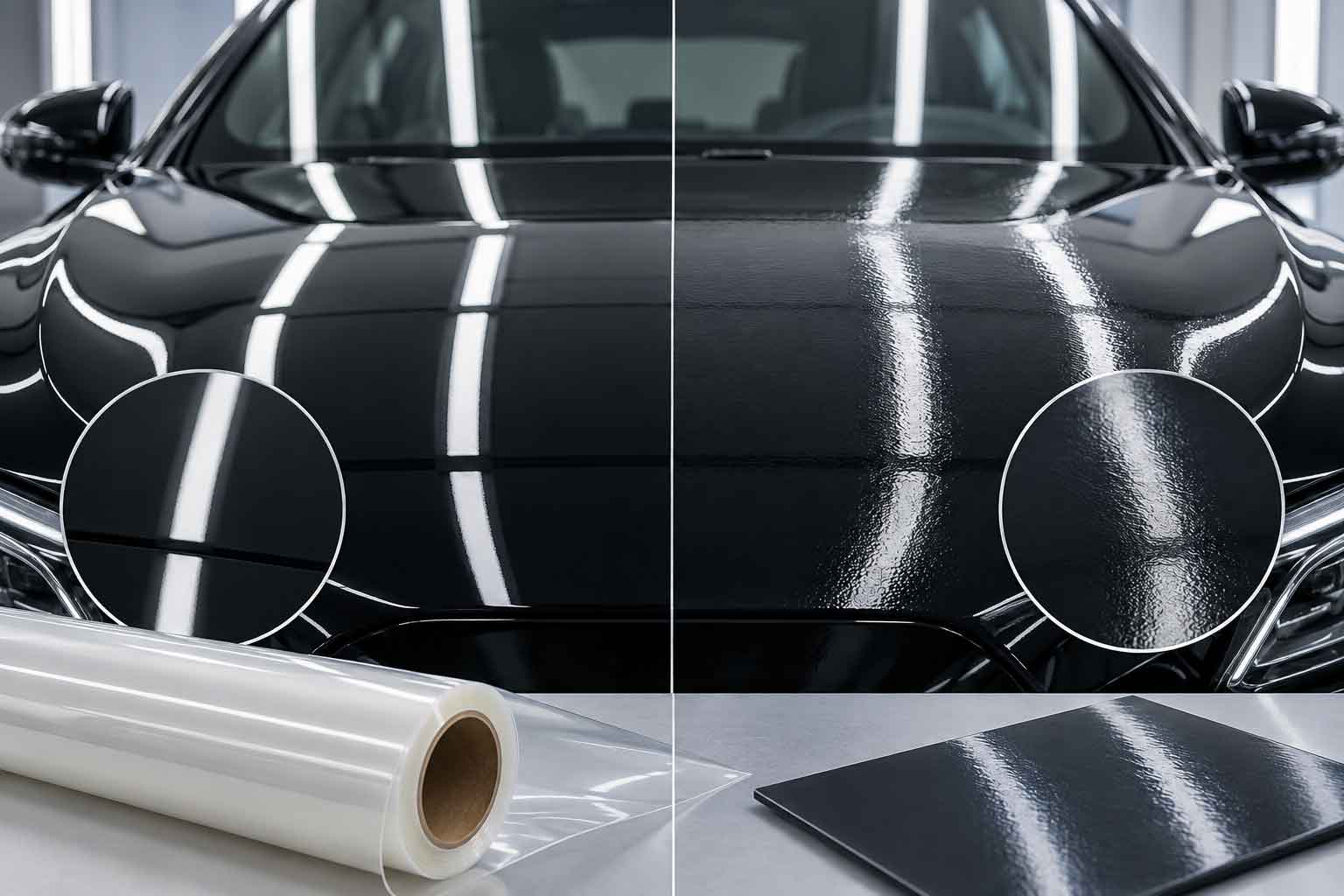
Clear PPF is transparent.
It can protect the surface, but it does not repair:
- sanding marks;
- orange peel;
- dust nibs;
- color mismatch;
- clearcoat texture.
In some cases, a glossy PPF may make reflected surface texture more noticeable.
This is why visual inspection should happen before installation.
For a deeper explanation of paint texture and film appearance, see our guide to PPF optical clarity and orange peel.
If the repaired paint does not meet the customer’s visual expectation before PPF, fix the paint first.
Can PPF Stick Well to Repainted Paint?
It can.
A fully cured, stable and properly prepared repaint may accept PPF very well.
But strong initial adhesion does not prove that the underlying paint system is equally strong.
This is the key distinction.
Imagine:
PPF adhesive → clearcoat
bond is strong.
But:
clearcoat → basecoat
bond is weak.
The film can appear perfectly installed.
The weakness may become visible only later during removal.
Successful Installation Does Not Guarantee Safe Future Removal
This is one of the most important points in the article.
A repainted panel may:
- install cleanly;
- remain stable for years;
- look excellent.
That does not guarantee the paint will stay attached when PPF is eventually removed.
Removal risk depends on:
- paint quality;
- layer-to-layer adhesion;
- repaint history;
- film age;
- adhesive aging;
- removal temperature;
- removal technique.
For this reason:
Installation success and removal safety are two different questions.
Our PPF adhesive and removal guide explains why adhesive residue and paint pull should also be treated as different problems.
Can PPF Pull Off Repainted Paint During Removal?
It can happen.
The risk is generally higher when the repaint has:
- poor layer adhesion;
- poor surface preparation;
- incomplete cure;
- previous coating failure.
If the paint-to-substrate bond is weaker than the force created during film removal, paint may lift with the film.
That does not automatically mean:
“The PPF adhesive was too strong.”
The failure may occur inside the paint system itself.
For the broader question of paint safety, see our guide: Does Paint Protection Film Damage Paint?.
Does PPF Warranty Cover Repainted Panels?
Do not assume it does.
This is especially important for:
- installers;
- distributors;
- private label brands.
Major PPF manufacturers often define warranty coverage around:
- sound OEM paint;
- properly prepared factory-painted surfaces.
Some explicitly exclude:
- repainted;
- repaired;
- aftermarket-painted surfaces.
A product may therefore physically install on a repaint while the manufacturer’s standard warranty does not cover that substrate.
These are different questions:
Can it be installed?
and
Is it covered?
Before installation, check:
- current product warranty;
- installer warranty;
- paint-related exclusions;
- removal-related exclusions.
Do not promise a customer a standard full warranty if the policy does not cover repaired paint.
Why Warranty Disclosure Matters for Installers
The installer should explain the difference before the job starts.
Otherwise, a future customer may assume:
“I bought a 10-year PPF, so the repaint is guaranteed for 10 years too.”
That is not necessarily true.
PPF warranty normally relates to the film under defined terms.
It does not automatically guarantee:
- body-shop workmanship;
- repaint adhesion;
- clearcoat stability.
Clear documentation reduces future disputes.
What Should Installers Ask Before Accepting the Vehicle?
A short intake form can prevent many problems.
| Question | Why It Matters |
|---|---|
| Has this panel been repainted? | Identifies non-OEM substrate |
| When was it painted? | Helps assess cure timing |
| Which body shop performed the repair? | Allows process confirmation |
| Why was the panel repaired? | Reveals previous paint failure or collision |
| Has the paint ever peeled or lifted? | Indicates adhesion risk |
| Has ceramic coating or wax been applied? | Affects surface preparation |
| Is the repaint warranty still active? | Helps coordinate responsibility |
The answers should be stored with the installation record.
What Should Be Documented Before PPF Installation?
For a repainted vehicle, installers should consider recording:
- vehicle details;
- panel location;
- repaint disclosure;
- repaint date;
- visible surface condition;
- photos;
- PPF product;
- batch or roll information;
- customer acknowledgement.
This protects both the customer and installer.
It also helps later if:
- removal occurs;
- a paint issue appears;
- warranty responsibility needs to be reviewed.
Why Photos Are Useful
Take clear photos before installing PPF over repaired paint.
Document:
- panel surface;
- existing defects;
- edges;
- paint texture;
- repair areas.
If a visible issue already existed before PPF, the record helps prevent confusion later.
For installer networks, standardized pre-installation photography is simple but valuable.
Are Panel Edges Higher Risk on Repainted Cars?
They can be.
Edges already involve:
- film tension;
- reduced contact area;
- trimming or wrapping;
- future removal force.
If the repair includes a weak:
- clearcoat edge;
- blend area;
- poorly bonded repair boundary,
extra caution is sensible.
This does not mean every repainted edge will fail.
It means the substrate condition should be known before using an aggressive edge-wrap strategy.
For edge-specific troubleshooting, see our guide on why PPF lifts at the edges.
What About Partial Repaints and Blended Paint?
This can be more difficult than a simple full-panel respray.
A repaired area may contain:
- original paint;
- blended basecoat;
- new clearcoat;
- transition zones.
The PPF installer may not be able to identify every repair boundary visually.
If the body shop can provide repair information, use it.
Do not assume that a panel described as “only a small repair” has the same substrate condition everywhere.
Should New Paint Be Polished Before PPF?
Only if the refinish process allows it and the surface needs correction.
Do not polish fresh repaint automatically.
The paint system may have specific:
- cure;
- polishing;
- coating
requirements.
If polishing is needed to correct:
- dust nibs;
- sanding marks;
- texture,
the body shop or qualified detailer should complete the paint work before PPF installation.
PPF should be the final protection step, not a substitute for finishing the repaint properly.
How Should Distributors and Installer Networks Manage Repainted-Panel Risk?
This is where the topic becomes a B2B quality issue.
A distributor can have excellent PPF and still receive complaints if installers apply it to unsuitable repaint.
The solution is not stronger adhesive.
The solution is a clear substrate policy.
A professional installer network should define:
OEM Paint
Standard process.
Repainted Paint
Additional inspection and disclosure.
Fresh Paint
Require cure confirmation.
Unstable Paint
Decline installation until repaired.
This gives different installers in the network a consistent decision process.
A Simple Repainted-Panel Decision Process
Use this logic:
Has the panel been repainted?
↓
Yes
↓
Is the repaint date known?
↓
Is the paint system fully cured according to relevant guidance?
↓
Does the surface look stable?
↓
Does the PPF warranty allow this substrate?
↓
Has future removal risk been explained?
↓
Install / Delay / Decline
This is more reliable than using one rule such as:
“Wait 30 days and install.”
How Private Label PPF Brands Should Handle Repainted Paint Claims
Private label brands should be careful with broad marketing language.
Avoid statements such as:
“Safe on all automotive paint.”
That is difficult to support.
A more responsible product position is:
designed for suitable, properly prepared automotive paint surfaces, with repaired or non-OEM paint requiring separate evaluation.
The exact warranty language should match:
- product testing;
- target market;
- local legal requirements;
- actual warranty policy.
This reduces the risk of promising more than the film manufacturer can control.
How FUNO Recommends Buyers Handle Repainted Panels
FUNO supplies PPF to professional distributors, installer networks and private label buyers.
For repainted panels, we recommend treating the substrate as a separate installation risk.
Before installation, confirm:
- repaint history;
- cure status;
- surface condition;
- existing coating;
- applicable warranty.
We do not recommend using PPF to compensate for:
- unstable paint;
- peeling clearcoat;
- incomplete repair.
For professional projects, substrate condition should be considered together with:
- film selection;
- adhesive behavior;
- installation method;
- removal expectations.
This creates a more realistic and defensible installation process.
PPF Quality Cannot Correct Poor Refinish Work
This point is important for distributors.
A premium PPF may provide:
- strong clarity;
- good adhesive;
- controlled stretch;
- stable edges.
But it cannot correct:
- weak clearcoat adhesion;
- bad primer preparation;
- uncured paint;
- failing repair layers.
This is why paint-related claims should not automatically be classified as film quality problems.
A good technical investigation separates:
film issue
from:
substrate issue.
FAQ
Can PPF be installed over repainted panels?
Sometimes.
A professionally repainted panel may be suitable if the paint is fully cured, stable and properly bonded.
The PPF warranty should also be checked before installation.
How long should I wait after repainting before installing PPF?
Some major PPF manufacturers publish a common waiting recommendation of around 30 days for fresh paint.
However, actual cure requirements vary by refinish system and process.
The body-shop or paint-manufacturer guidance should be confirmed.
Can PPF be installed over fresh paint?
Do not rush.
Fresh paint should complete the required cure before adhesive film is applied.
If cure status is uncertain, delay installation.
Will PPF pull off repainted paint?
It can if the paint system has weak adhesion.
The risk is usually higher on repaired or aftermarket paint than on sound OEM paint.
Does successful PPF installation mean the repaint is safe?
No.
A panel can install successfully and still carry future removal risk if the paint layers are weak.
Can a paint thickness gauge tell whether repaint is safe for PPF?
No.
It can help identify possible repaint history, but it does not measure paint adhesion quality.
Does PPF warranty cover repainted panels?
Not always.
Many major brands limit standard warranty coverage to OEM-painted surfaces and exclude repainted or aftermarket paint.
Always check the current warranty.
Will PPF hide sanding marks or orange peel from a repaint?
Not reliably.
Transparent PPF generally follows the underlying surface.
Paint defects should be corrected before film installation.
Repaint Readiness Is More Than a Waiting Period
PPF can sometimes be installed successfully over repainted automotive panels.
But the correct decision should not be based on one number of days.
The installer needs to understand:
paint history + cure status + surface condition + paint adhesion risk + PPF warranty + future removal
The most important rules are:
Do not install over unstable paint.
Do not confuse dry paint with fully cured paint.
Do not assume 30 days is universal.
Do not assume successful installation guarantees safe removal.
Do not promise standard warranty coverage without checking the policy.
For installers, the correct question is:
Is this substrate ready?
For distributors and private label brands, the bigger question is:
Does our installer network have a consistent process for handling non-OEM paint?
FUNO supports professional buyers with PPF selection, specification alignment, sample evaluation and repeat supply through our PPF OEM and private label service.
A good PPF protects good paint.
It should not be expected to repair or stabilize paint that was already weak before installation.
Related Posts

Contact FUNO
Tell us your target market, product category, preferred specification, estimated purchasing volume, and whether you need standard or private label supply.
FUNO can help you narrow suitable film options, sample requirements, packaging needs, and the next step toward bulk purchasing.